Showing posts with label Les Thatcher. Show all posts

Sunday, February 22, 2026

History of Georgia Wrestling on Television

The following is a post by Georgia Wrestling historian Rich Tate from 2003 on the old Wrestling Classics message board. It is included here for historical purposes. [LINK]

More specific information about the period following Black Saturday in July of 1984 can be found on the Mid-Atlantic Gateway in the article Ole and Solie: The Evolution of TV Wrestling in Georgia after Black Saturday. 

* * * * * * * 


RICH TATE: I am attempting to piece together a timeline for wrestling on TV in the Atlanta area. Can anyone make corrections or fill in gaps? Especially after Black Saturday...that's where my most confusion lies. Also, if anyone can add to it by adding in what may have been happening in Macon, Columbus, Augusta and Savannah, it's very much appreciated. (Bold and italicized text is mine.)

1954: Live Atlanta Wrestling first appeared on WLWA Channel 11 (ABC affiliate), a three-year-old station, hosted by Ray McCay, who had previously been doing the radio broadcasts of local shows on WQXI-AM 790. The show would jump around the schedule throughout its run on this station, and seemed to become an afterthought more and more as time went on. Prior to that, local fans could only see what the network feeds brought in, and more recently, the shows had been sent in via tape from Texas.

1955: Ed Capral, who had been the ring announcer, replaces McCay on Live Atlanta Wrestling.

1961: Channel 11 ownership changed hands, and its call letters became WAII.

1969: Once again, new owners took over at Channel 11, and the call letters became WQXI.

1970: On January 1, Atlanta independent UHF Channel 17 (WJRJ) is purchased by Ted Turner and renamed WTCG. Les Thatcher began working as a co-host and associate producer, a position he would hold for three years.

1971: Live Atlanta Wrestling changed its name to Georgia Championship Wrestling, beginning with the program shot on August 14. On December 25, Georgia Championship Wrestling aired for the first time on WTCG in a permanent time slot, with taping in the afternoon, and airing each Saturday at 6:00 pm. This was the reason the promotion decided to change stations. It had become very difficult to keep fans coming to the studios for live matches when the schedule was so varied at Channel 11.

1972: In June, WTCG begins re-airing its Saturday tape on Wednesday night as a prime time replay. This lasted until the fall. On December 2, WTCG began airing back to back episodes of Georgia Championship Wrestling and All-South Championship Wrestling in back to back Saturday evening slots. Capral changed over immediately to the All-South program, and Sterling Brewer was called in to cover the announcing for GCW, while maintaining his job in Birmingham for Nick Gulas’ show.

1973: Brewer was replaced on Georgia Championship Wrestling by Gordon Solie, who continued to do the announcing for Championship Wrestling from Florida out of Tampa. During the summer, Georgia Championship Wrestling shifted to morning hours to tape their programs.

1974: After the closing of All-South, Georgia Championship Wrestling continued on as the sole wrestling show on WTCG.

1976: A second program, called Best of Georgia Championship Wrestling, began airing on WTCG hosted by Freddy Miller. On December 17, WTCG became the second satellite-delivered cable program service (behind Home Box Office), and the first satellite superstation. The first Georgia Championship Wrestling show that could be seen beyond Atlanta was taped and aired on December 18.

1979: WTCG changed its call letters to WTBS on August 27, with the first Georgia Championship Wrestling show taped and aired on September 1.

1982: Georgia Championship Wrestling changed its on-air name to World Championship Wrestling.

1983: A co-promotion initiated between Ole Anderson and Jerry Jarrett called GCW Superstars aired for three months on WTBS, produced and hosted by Les Thatcher.

1984: On July 7, the final episode of World Championship Wrestling taped and aired on WTBS, and fans were introduced to WWF programming the following week. The WWF debuted on July 14 in WCW’s former time slot, on a day that has been dubbed by fans as “Black Saturday.” In September, a new promotion operated by Ole Anderson and Ralph Freed got an early morning time slot on WTBS each Saturday. The promotion and the show were both called Championship Wrestling from Georgia, and Gordon Solie was back as the announcer. Meanwhile, Turner sold a Sunday night time slot on WTBS to Mid-South Wrestling, hosted by Jim Ross.

Gateway Note: More specific information about the period following Black Saturday in July of 1984 can be found on the Mid-Atlantic Gateway in the article Ole and Solie: The Evolution of TV Wrestling in Georgia after Black Saturday. 

1985: Jim Crockett bought the Championship Wrestling from Georgia business and time slot on WTBS, and began airing World Championship Wrestling on the time slot he purchased from Vince McMahon. This version of the program was hosted by David Crockett and Tony Schiavone. 

Joe Pedicino began producing and hosting a show on WATL Channel 36 (Independent) that aired each Saturday night, starting at 8:00 pm. It lasted through 2:00 am, and showed tapes from various promotions around the world in their entirety.


Some responses are included below with additional or clarrifying information.

[A] KING COMBO: 
1983: A co-promotion initiated between Ole Anderson and Jerry Jarrett called GCW Superstars aired for three months on WTBS, produced and hosted by Les Thatcher."

AFAIK, didn't the full shows only air in Chattanooga (where the show was taped), and only selected matches aired on the Sunday show w/ other GCW footage?

"1984: On July 7, the final episode of World Championship Wrestling taped and aired on WTBS, and fans were introduced to WWF programming the following week. The WWF debuted on July 14 in WCW’s former time slot, on a day that has been dubbed by fans as “Black Saturday.” In September, a new promotion operated by Ole Anderson and Ralph Freed got an early morning time slot on WTBS each Saturday. The promotion and the show were both called Championship Wrestling from Georgia, and Gordon Solie was back as the announcer. Meanwhile, Turner sold a Sunday night time slot on WTBS to Mid-South Wrestling, hosted by Jim Ross."

The show was still called World Championship Wrestling (in the intro and on the studio banner) after Black Saturday. The "coming up next..." slates on TBS still referred to the show as Georgia Championship Wrestling, as did Gorilla Monsoon. The show had original interviews at this point but no original matches.

It is worth noting that of the 3 shows, Mid-South drew the highest ratings (making it the highest rated show on cable at the time).

"1985: Jim Crockett bought the Championship Wrestling from Georgia business and time slot on WTBS, and began airing World Championship Wrestling on the time slot he purchased from McMahon. This version of the program was hosted by David Crockett and Tony Schiavone. 

Joe Pedicino began producing and hosting a show on WATL Channel 36 (Independent) that aired each Saturday night, starting at 8:00 pm. It lasted through 2:00 am, and showed tapes from various promotions around the world in their entirety."

Somewhere in February-March, the WWF buckled to Turner's pressure and moved the W/GCW show to the studio on Techwood Drive for its own tapings w/ Gorilla Monsoon as host and Freddie Miller as ring announcer. This lasted about a month or so before the slot was sold to Crockett. These tapings featured the studio returns of Mr. Wrestling II & Roddy Piper.

"1986: Ann Gunkel starts a second version of All-South Championship Wrestling that aired for several weeks on WANX Channel 46 (Independent), hosted by Les Thatcher."

I believe this was the year of the first showing of the "History of Atlanta Wrestling" special on WATL, along w/ the first Wrestlethon (24 hours of various footage hosted by Pedicino w/ phones manned by wrestling personalities taking donations for local charities). Wrestlethon '88 featured the return of live studio wrestling in Atlanta, w/ several matches done at WATL, and a feature on the Fox Network's late show.

Someone else probably knows more about North Georgia, SCW, NWA Georgia/Wildside, etc.

[B] RED MASK: Rich, Championship Wrestling From Florida w/Gordon Solie aired on WTCG Channel 17 Saturdays at 7pm right after GCW at 6pm around late '74/'75 after All-South went down.

[C] CINCINNATI KID: wish I could give you more information on the wrestling on TV in Atlanta. I do note that the station that initiated the shows was WLW-A, which was owned by the Crosley Broadcasting Company's division of Avco. It was that same company who started TV wrestling in Cincinnati on WLW-T, then on Channel 4, on February 4, 1950. In time, the Crosley affiliates in Dayton, Ohio - WLW-D, Channel 2, and in Columbus - WLW-C, Channel 4, (after the Cincinnati station moved to Channel 5), all began carrying matches from the Al Haft promotion. Matches were aired on Saturday afternoons and Saturday nights. By the early 1960's, even WLW-I in Indiapolis was airing TV matches of the Haft promotion out of Dayton with the other WLW stations likewise picking up the feeds. As with other programming and in the area of engineering, Crosley was always at the forefront. 

Tuesday, May 21, 2024

Les Thatcher: Studio Promo Tapings at WRAL in the 1970s

Conversations with Les Thatcher:
Local Promo Tapings for Jim Crockett Promotions (1970s) at WRAL
Originally published on the Mid-Atlantic Gateway

From 1974 - 1977, Les Thatcher hosted and conducted the local promos that were inserted into each Mid-Atlantic and Wide World Wrestling show for each local market. The shows were taped at WRAL TV studios in Raleigh, NC. We talked with Les about how and when those promos were done, offering interesting insight to the making of Mid-Atlantic Championship Wrestling on television.

*********************************


Les Thatcher

Dick Bourne: The tapings in Raleigh were on a Wednesday night, I remember. Did you do the local spot promos before the tapings?

Les Thatcher: Yes. What we did, we usually started about noon, and we used to average over a hundred spots a Wednesday afternoon.

DB: I can believe it, given the number of markets.

LT: That show was in 30-some markets and we had two 2:20 spots per show, plus some of the 30 second promos we cut to go into some of those markets, too. And then occasionally some of the boys might be booked out to Eddie Graham or down to Atlanta, so we’d cut promos to ship out to them. Of course, as antiquated as it all sounds now, back then it worked. I would go into the (Charlotte) office on Monday and George Scott would give me the line-ups, start times, buildings, towns, and so forth. I had an office in the (wrestling) office, but I also had an office at home, They didn’t much care where I worked as long as I got the stuff done. But I would take that old yellow newsroom-type paper, perforated paper that would fold; Jimmy (Crockett) bought that for me by the box. It would fold easy, and I would take a grease pencil and I would write, for example, Friday Night, June the 6th, Richmond, Virginia, the Coliseum, bell time, whatever, and then I would list a few stars, and then one or two matches and the stipulations. And we often would plug three towns off of the same TV. Those were my cues. Nothing was written out for me, there were no teleprompters, no cue cards.

DB: I always wondered if someone was holding cue cards.

LT: Well, Danny Miller helped out with it. Gene Anderson was working in the office at the time, he helped out with it. George Scott himself would help. What they did was take my folded stack of paper and tape them to the top of a music stand, because the post on the music stand was adjustable, and they would make it just high enough that it would fit right under the camera lens. So let’s say, Flair and I are finishing up the last 2:20 on the Richmond tape, and I’ve got that music stand with the Richmond info sitting in front of me; Ric’s on my left, and he’s doing his pitch. And we had a back timer, like photographers use, and that’s how we kept our time. And that was on a stand sitting right there, too. So anyway, we’d wrap up that 2:20 for Richmond, he would step off to the left, Gene or George or Danny or whoever would change the music stand, and now we’ve got the first 2:20 for Raleigh, for example. And then here comes Blackjack in on my right. And we’d hit that 2:20, and then for the same show we’d do the 2:20 (with Blackjack’s opponent) in on the other side . . .

DB: So you would do each city’s promos back to back, babyfaces and then heels?

http://
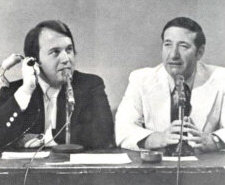
Les Thatcher and Bob Caudle (1974)

 HOME  |  MID-ATLANTIC BOOK STORE  |  STUDIO DIRECTORY
ABOUT  |  CONTACT  |  MID-ATLANTIC GATEWAY  |  DOMED GLOBE


LT: Yes, and I got off of that set for two reasons and two reasons only: to go to the bathroom or to grab a quick bite to eat. That was probably the first place I worked where they catered anything in because we were there so long. Now days, it’s standard procedure in both TV companies to have food catered in. But back then, they’d bring in Col. Sanders for us. And also, as well as I was dressed (for the TV), I finally succumbed to crape-soled work shoes because I was standing on that concrete so much.

DB: And your shoes never showed on TV . . .

LT: Exactly. So once I was aware of that, I said, hell I’m driving myself crazy wearing these shoes. We would start at noon and sometimes it was 5 o’clock before we were finished.

DB: I don’t see how your voice held out.

LT: I’m not sure, either, to tell you the truth, Dick. And the funny thing is, I got that 2:20 in my head, you’re doing a hundred of these every Wednesday. But there were times that someone would step on the plug of that back timer, or for whatever reason it would stop, I would keep the interview going, and I swear to you, I could finish it within a couple of seconds one way or the other of the exact time, because I had done them so many times. And then I go to Knoxville and do my spots up there (for Southeastern Championship Wrestling.)

DB: I guess you just get in a rhythm.

LT:  Exactly. My schedule, when I was doing both shows between November of 1974 and February or March of 1978, before I moved to Knoxville, I would, as I said, go in (to the Charlotte office) and get the stuff from George (Scott) on Monday. I was helping with the magazine, and the TV in Charlotte, plus I was wrestling a couple of nights a week, and then we’d go to a show on Tuesday, and then drive up from Charlotte early that Wednesday morning, did promos from noon to 5 o’clock, grabbed a bite to eat, I was hosting the one show, Bob Caudle was hosting the other. And then once I started doing the Knoxville show, I think Jimmy was afraid people would see Les on two shows in the same market, and that’s basically when Ed Capral came in.

DB: That must have been in 1975 or 1976, because when I first discovered Wide World Wrestling on channel 13 in Asheville, Ed Capral was the host. I never knew you hosted one of the (Mid-Atlantic) shows until I read it on your site. We didn't get the second Mid-Atlantic show where I grew up.

LT: You mentioned channel 13 in Asheville earlier; do you know in that three-station market what our share or percentage of homes tuned in to that show was?

DB: I remember knowing that it was huge . . .

LT: Between 70-80%.

DB: Good grief! 

LT: Yep, when our show was on the air in that three station market, our show was watched by between 70 and 80 percent of the homes available to those three stations.

DB: Unbelievable.

LT: Another guy in the Crockett office, who wasn’t involved in the wrestling, we put together a promotional packet, laid out the design for the little cover and all that, and in there we had a sampling of the different markets we were in and what kind of shares and numbers we pulled there. That’s how I remember the Asheville thing so vividly. So when people think wrestling’s popularity started with Hulk Hogan, it just drives me crazy. But anyway, we’d do the TV in Raleigh on Wednesday, and then Thursday, I’d wrestle for Crockett someplace, then Friday morning, I would get on Piedmont Airlines, remember them?

DB: I certainly do. My Dad flew them every week for awhile.

LT: I would get on a Piedmont flight in Charlotte that hopped into Greenville/Spartanburg, then into Asheville, and it finally got me to Knoxville. Ron (Fuller) would pick me up at the airport, we’d do lunch, go to his house, we’d lay out the TV, I helped him with the booking along with Nelson Royal, then we’d work Knoxville Friday night, and then do TV Saturday morning, work a house show some place Saturday night and I’d get back on the bird Sunday morning, and I’d do it all over again.

*******************************************  

Special thanks to Les Thatcher for his insights on the studio promo tapings at WRAL. [GATEWAY]

Les educated us on the promo tapings in the 1970s. Jim Cornette shared some amazing information on one of his podcasts about the Crockett studio promo tapings in ther 1980s, at the make-shift TV studio in the garage at Briarbend Drive:

Jim Cornette Explains All About the TV Distribution Process for JCP in the 1980s

*********************************

In 1974-1975, Les Thatcher and Bob Caudle both hosted a separate hour of Mid-Atlantic Championship Wrestling taped at the studios of WRAL in Raleigh NC. Bob's show was the primary show (or "A" show) and aired in all Mid-Atlantic markets. Les's "B" show aired in select markets that supported a second hour of JCP wrestling, and usually on a different station on those markets.

For example, in the Greenville/Asheville/Spartanburg market, the Caudle show aired on WFBC-TV channel 4, the NBC affiliate out of Greenville SC at 1:00 PM on Saturday afternoons. Thatcher's show aired at 11:30 PM on WLOS-TV channel 13, the ABC affiliate out of Asheville NC.

Wednesday, November 2, 2016

Southeastern Championship Wrestling (Dothan)

Charlie Platt and Les Thatcher

A shot from early 1981, Charlie Platt and Les Thatcher hosting the show in the southern end of the Southeastern Championship Wrestling territory, taped at the studios of WTVY-4 in Dothan, Alabama. Thatcher also hosted the show in the northern end of the territory at that time out of Knoxville, Tennessee.

Later that same year, Ron Fuller sold the Knoxville territory to Blackjack Mulligan and Ric Flair, and concentrated his efforts out of the territory formerly known as Gulf Coast Wrestling which consisted of major towns such as Pensacola in the panhandle of Florida and cities in Alabama such as Mobile, Montgomery, and Birmingham.

Wednesday, October 19, 2016

Southeastern Championship Wrestling (Knoxville)

Les Thatcher and Phil Rainey on the set of "Southeastern Championship Wrestling"

"Southeastern Championship Wrestling" emanated from the television studios of WBIR-10 in Knoxville, TN. It was the NWA promotion in the mid-to-late 1970s that covered East Tennessee and later parts of Northern Alabama.

The host of the show was veteran wrestler and broadcaster Les Thatcher. His frequent co-host and promo announcer was Phil Rainey, who was one of the lead sports personalities at WBIR.

Rainey's voice is heard over the opening theme song to "Southeastern Championship Wrestling" uttering these famiar words:

"Welcome to Southeastern Championship Wrestling, featuring slow motion, instant replay, and other technical firsts. The program voted number one by the Wrestling Writers Federation. Join us now for the fast paced competition of professional wrestling, featuring the top stars from the world's largest governing body, the National Wrestling Alliance."
Thatcher was one of wrestling's busiest men (still is!) as he not only hosted the program out of Knoxville, but produced it as well. He also published the area's arena program and magazine, was a photographer, organized the local promotional spots, sold advertising, and occasionally still wrestled - - a renaissance man if there ever was one!

We are proud to spotlight this great photo from the Southeastern Championship Wrestling studio.

http://www.midatlanticgateway.com/p/us-title-book.html

Tuesday, July 5, 2016

Rare Studio Shot in WRAL (1975)

Ric Flair, Les Thatcher, and Johnny Valentine on the set of "Mid-Atlantic Championship Wrestling", 1975
Photo by Ric Carter

What a rare and special image from the studios of WRAL-TV in Raleigh, NC, in 1975. Ric Flair (wearing the Mid-Atlantic TV championship belt), host Les Thatcher, and U.S. Champion Johnny "The Champ" Valentine are apparently waiting to come back from a commercial break, as you can see the floor director or camera operator leaning against the ringpost.

LATER EDIT: Since originally posting this, we have learned that the photographer that took this shot is Ric Carter. We hope to provide more information on him and his work in a future post.

At that point in time, two separate versions of "Mid-Atlantic Championship Wrestling" were taped on Wednesday nights, one hosted by long time Raleigh announcer Bob Caudle, the other hosted briefly by Sam Menacker and then regularly by Les Thatcher. After the consolidation of Charlotte and High Point TV tapings into Raleigh, the Thatcher-hosted "B" show replaced those shows in markets where more than one hour of Crockett programing aired.

This second hour of the show featured all different interviews and matches than the first hour.

This second hour of "Mid-Atlantic Championship Wrestling" was later replaced by the new "Wide World Wrestling" show in October of 1975, which would be hosted by longtime Georgia wrestling host Ed Capral.

Thanks to Doc Hopper on Facebook for sharing this image with us, which he found on the Net.

Wednesday, August 5, 2015

Sound Bytes: Les Thatcher (1975)


Back in the mid-1970s, the television hosts for Jim Crockett Promotions would always run down the list of current champions that week. Bob Caudle, Les Thatcher, Ed Capral, Rich Landrum - - they would announce that the show was sanctioned by the National Wrestling Alliance and then list all of the champions, starting with the NWA world heavyweight champion.

In this example, Les Thatcher announces the NWA sanctioning and runs down the champions of the NWA in July of 1975.

From the 2nd hour of Mid-Atlantic Championship Wrestling taped 7/23/75 at WRAL in Raleigh:


Les Thatcher

Quite a distinguished list of champions!

NWA World Heavyweight Champion: Jack Brisco
NWA World Jr. Heavyweight Champion: Hiro Matsuda
NWA World Tag Team Champions: Gene and Ole Anderson
United States Heavyweight Champion: Johnny Valentine
Mid-Atlantic Heavyweight Champion: Wahoo McDaniel
Mid-Atlantic Television Champion: Ric Flair

Saturday, July 25, 2015

Ed Capral Profile

by Les Thatcher
from Mid-Atlantic Wrestling Magazine (Vol. 2 No. 3, 1976)


"Welcome ladies and gentlemen to Wide World Wrestling."

Ed Capral
The words are spoken and yet another program is being recorded in the studios of WRAL-TV in Raleigh. The tape machines are humming; the camera men are awaiting their cues; the director and engineers are giving instructions to the floor crews.

In front of the camera, however, away for all of this hustle and bustle stands a quite composed gentleman from Atlanta, Mr. Ed Capral. In a manner now familiar to wrestling fans throughout the southeast, Ed tells viewers what they are about to see. Then "Right after this word from our sponsor," cameras break away for a commercial and Ed makes his way to his desk where he will describe the action in a way that only he can.

All of this explanation sets the stage to answer the question "Who is Ed Capral?

Ed is one of the most experienced voices of wrestling beginning as a guest commentator 30 years ago. Ed was given the guest shot by Atlanta promotor Paul Jones and from that time has never looked back.

After attending the University of Georgia and serving a tour of duty in Korea, Ed returned to television where he would become the voice of Georgia Championship Wrestling for the next 20 years. Many wrestlers were to come and go but Ed remained vigile at his post.

In 1975 Ed joined Wide World Wrestling as the voice of this new program. Now the program is gaining popularity in the Mid-Atlantic area by leaps and bounds.

Ed may not go down in the annals of sports broadcasting history but his face and voice bring the same reaction from wrestling fans as Howard Cosell, Curt Gowdy, and Pat Summerall get from football fans.

"This is Ed Capral saying so long until next week." 

He wipes his face; shakes a few hands; packs his bag; and leaves for the airport for his trip back to Atlanta.

Monday, June 29, 2015

Television Wrestling History: WRAL-5 Raleigh, NC

WRAL TV in Raleigh is the studio location most closely associated with Jim Crockett Promotions and Mid-Atlantic Wrestling. Studio A at WRAL was the site of weekly TV tapings for over three decades. By 1974, all of the remaining regional taping locations (WFBC, WGHP, WBTV) had ceased, and all Crockett TV taping was consolidated into this location.


At that point, two versions of Mid-Atlantic Championship Wrestling were taped, one hosted by long time Raleigh announcer Bob Caudle, the other hosted briefly by Sam Menacker and then regularly by Les Thatcher. The Thatcher-hosted "B" show replaced WGHP's Championship Wrestling in markets where it was also syndicated at the time. (Example: Asheville's WLOS-TV).  On October 8, 1975, a new program called Wide World Wrestling, hosted by long time Atlanta wrestling announcer Ed Capral, replaced the Thatcher version of Mid-Atlantic Wrestling. Thatcher would continue to do the local promo spots to be inserted in the local broadcast of each show. (Thatcher also produced and hosted the Southeastern Championship Wrestling program for Ron Fuller in Knoxville, TN. during this period.) Capral left the promotion in late 1977 and was replaced by Tom Miller and George Scott. On the weekend of October 7, 1978, Rich Landrum became the permanent host of the show, which was renamed World Wide Wrestling.


Bob Caudle's main co-host was David Crockett through the WRAL period. Tom Miller filled in during the summer of 1976 when David Crockett was tending to another family business with sister Frances Crockett, the Charlotte O's minor league baseball franchise. Big Bill Ward, who hosted Championship Wrestling for Crockett Promotions in Charlotte on WBTV from the late 1950s through early 1970s, briefly co-hosted with Bob Caudle on the 2nd Mid-Atlantic show after TV tapings had been consolidated to Raleigh. Lord Alfred Hayes had a brief stint as co-host in 1980.  Landrum's regular co-host on World Wide Wrestling would eventually be Johnny Weaver.

Prior to this consolidation, in the 1960s and early 1970s, WRAL was actually the site of one show only, a one-hour taping with simultaneous "dual" audio tracks being recorded. As they taped the matches, they had two broadcasters calling the action separately. Nick Pond, a WRAL sportscaster, hosted the show that would be seen in the Raleigh market (with co-host Joe Murnick much of that time, who was also the local Raleigh promoter), while at the same time one desk over, Bob Caudle called the action for a tape that was sent out to other markets in the Mid-Atlantic area that didn't have their own local TV tapings. Both Pond and Caudle also did sports and weather for WRAL television. Elliot Murnick replaced Pond on the Raleigh broadcast around 1972-1973. For most of this time, the Raleigh show was called Championship Wrestling and the syndicated show was called All-Star Wrestling. When all of the other studio locations ceased taping by 1974, Caudle became the sole host of what was now titled Mid-Atlantic Championship Wrestling which was now sent to all of Crockett's TV  markets including the home base of Raleigh.

Wrestling first debuted on WRAL on January 31, 1959 at 5:00 PM. The show at the time was titled Championship Wrestling. In the earliest days of wrestling on WRAL, the legendary broadcaster Ray Reeve called the wrestling action before turning over the duties to Pond, who was Reeve's assistant early in his career at WRAL. Reeve was the long time radio voice of the North Carolina State Wolfpack and was the first broadcaster inducted to the North Carolina Sports Hall of Fame. (On a side note, Charlie Harville, the long time host of wrestling taped at WGHP in High Point NC in the 60s and 70s, was the 2nd broadcaster inducted into NC Sports Hall of Fame.) 

But the voice most associated with WRAL wrestling will forever be the one and only Bob Caudle, a long time employee and on-air personality at WRAL, who continued to do TV for the Crocketts when they moved production to WPCQ in Charlotte and then took the production out to the arenas. Caudle is still loved by wrestling fans today, recently receiving a standing ovation at a wrestling legends show in Spartanburg SC. He was an inaugural inductee into the Mid-Atlantic Wrestling Hall of Heroes in August of 2007. Fans still call for his trademark show closer, "We'll see you next week fans, and until then, so long for now."

  - Dick Bourne


BASIC INFORMATION
Call Letters: WRAL
Channel Number: 5
Network Affiliate:
ABC  (Originally NBC, now CBS)
Began Taping Wrestling:
Late 1950s
Earliest known broadcast: January 31, 1959
Ceased Taping Wrestling: July 29, 1981 (Final Taping)
Play-by-play Hosts:
MID-ATLANTIC WRESTLING:
Raleigh telecast (1960s - approximately 1972): Ray Reeve, Nick Pond, Elliot Murnick
Syndicated telecast: Bob Caudle, Les Thatcher, Sam Menacker (briefly)

WIDE WORLD / WORLD WIDE WRESTLING:
Ed Capral, Tom Miller, George Scott, Russ Debuq, Rich Landrum
Color
Commentators:
MID-ATLANTIC WRESTLING:
David Crockett, Tom Miller, Joe Murnick (Raleigh version only) Short term: Lord Alfred Hayes, Big Bill Ward. (There were brief runs by several others including Sandy Scott, Roddy Piper, and Sir Oliver Humperdink)
WIDE WORLD / WORLD WIDE WRESTLING::
Johnny Weaver, George Scott, Tom Miller (There were brief appearances by several others.)
Ring Announcers:
Joe Murnick, Carl Murnick, Elliott Murnick, David Crockett, Jim Crockett
Local Promos:
Bob Caudle, David Crockett, Rich Landrum, Ed Capral, Les Thatcher, Bill Connell, a couple others yet identified.
The famous commercial bump "Let's take time for this commercial message about the Mid-Atlantic Wrestling events coming up in your area..." was voiced by WRAL weatherman Bob Debardelaben.
Taping night: Wednesday nights
Show titles: Championship Wrestling, All Star Wrestling, Mid-Atlantic Championship Wrestling, Wide World Wrestling, World Wide Wrestling

Tuesday, June 16, 2015

Les Thatcher Schools Us on WRAL Local Promo Tapings

From the Mid-Atlantic Gateway archives, we take you to one of our conversations with the great Les Thatcher who told us all about those marathon local-promo taping sessions at WRAL.

Conversations with Les Thatcher:
The WRAL Local Promo Tapings

Just as an aside, this interview was conducted in 1999, and was a part of the original material posted on the Mid-Atlantic Gateway when it launched in 2000. Les has always been a friend to the Gateway and we can't say enough good things about him.

And in this photograph, he is sporting our WRAL Studio Crew sweatshirt we gave him!

Saturday, September 15, 2012

Mid-Atlantic Wrestling hosts Les Thatcher and Bob Caudle


     In 1974-1975, Bob Caudle and Les Thatcher both hosted a separate hour of Mid-Atlantic Championship wrestling taped at the studios of WRAL in Raleigh NC. Bob's show was the primary show (or "A" show) and aired in all Mid-Atlantic markets. Les's "B" show aired in markets that supported a 2nd hour of Crockett Wrestling, and usually on a different station on those markets. 

     For example, in the Greenville/Asheville/Spartanburg market, the Caudle show aired on WFBC-TV channel 4, the NBC affiliate out of Greenville SC at 1:00 PM on Saturday afternoons. Thatcher's show aired at 11:30 PM on WLOS-TV channel 13, the ABC affiliate out of Asheville NC.

     For more on the WRAL studio shows, visit the WRAL Studio Wrestling page on the Mid-Atlantic Gateway.