 |
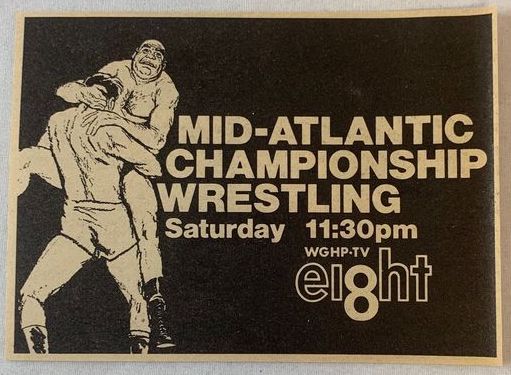
| I miss when wrestling was a one-hour, Saturday, late night type of thing. |

 |
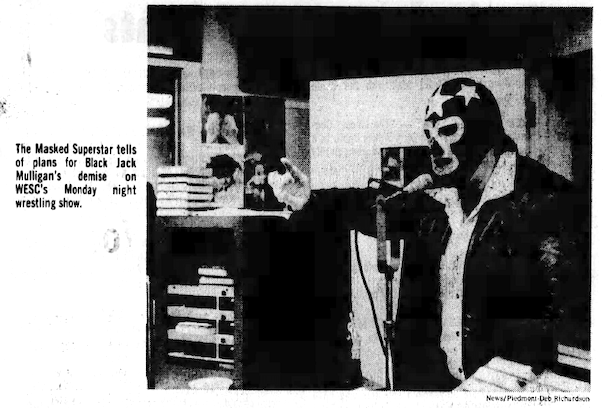
| Greenville News (Greenville SC) May 14, 1978 Article by Deb Richardson Clippings from the collection of Mark Eastridge |
"The Wrestling Show" aired on WESC FM in Greenville, SC at midnight on Monday nights after the weekly matches in the Greenville Memorial Auditorium. This was in the mid to late 70's. WESC midnight-to-6:00 am DJ Fred Nabors was the host.
 |
| Fred Neighbors (center) with Ric Flair and Greg Valentine |
Sandy Scott, Crockett's local promoter at the time, was in studio also. They would have the results from the night's event, play taped interviews from earlier the same night that Fred Nabors would conduct before the matches and tape them for play on the show. Usually, they would get some of the guys to stay in town and go live on the air during the show.
 |
| Ric Flair, Greg Valentine, Sandy Scott |


In the late 1970s, Roanoke promoter Pete Apostolou tagged a little promotional audio segment onto the end of the Mid-Atlantic Championship Wrestling program that aired on WSLS-10 in the greater Roanoke market. Apostolou was the local promoter for Jim Crockett Promotions. His own promotional company was called The Roanoke Sports Club.
After Bob Caudle would preview the matches for next week's show, you would hear the following:

"Mid-Atlantic Wrestling has been a presentation of WSLS TV-10 in association with the Roanoke Sports Club. Join us next Saturday afternoon for Mid-Atlantic Wrestling!
For complete information about sponsorship of wrestling matches in your area, contact the Roanoke Sports Club, Post Office Box 1855, Roanoke, Virginia, 24008."
This of course was only heard on the Roanoke version of Mid-Atlantic Wrestling, but was indicative of Apotolou's additional efforts to promote his towns in the Roanoke area, that included Lynchburg and other spot show towns.
(Includes rare, exclusive audio tracks embedded below.)
When I first got "hooked" on Mid-Atlantic Wrestling, one of the things (other than the great wrestling) that I liked most about both Crockett shows was the great theme music.
I'm not talking about wrestler's theme music. This was in 1975 and almost a decade before every wrestler had their own theme music.
I'm talking about the opening theme music that started off each show. It was a signature element of each of the two programs that Jim Crockett Promotion produced, and is today as much of the sentimental or nostalgic aspect of those shows. That's something long ago lost as it regards pro-wrestling on TV today.
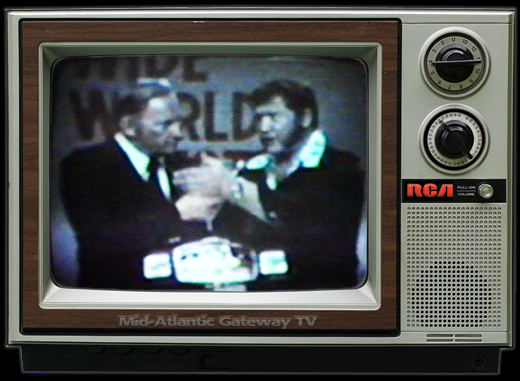 |
| Ed Capral with NWA champion Harley Race on the set of "Wide World Wrestling" in 1977 |
 |
| "Truckin'" Tom Miller, host of "Wide World Wrestling" for roughly 6 months in 1978 |
:format(jpeg):mode_rgb():quality(40)/discogs-images/R-3544026-1335781394.jpeg.jpg)
The "Wide World Wrestling" theme was created by taking various segments of the original 1:30 recording and piecing them together to make the final 25 sec. version you heard each week to open the show. The tempo of the wrestling version was also a little faster than the original, although at the same pitch.
I took Murphy's original recording and edited a version together that is nearly identical (in arrangement and speed) to the classic 1975 wrestling theme, and happily present it here.
There are no known video recordings of the 1975-1978 "Wide World Wrestling" show, which is a very sad thing. The theme hasn't been heard in this arrangement since 1978, so only fans who are roughly in their mid-40s or later would even remember it. But for those that watched "Wide World Wrestling" every single weekend without fail as I did each week, this will be a wonderful trip down memory lane and a nostalgic reminder of a great era in Mid-Atlantic Wrestling. And for those hearing it for the first time, this is what a real wrestling theme sounds like.

Wide World Wrestling - Opening Theme (1975-1978)
Wide World Wrestling - Closing Theme (1975-1978)
More on this album of production music on the Discogs website:
https://www.discogs.com/Walter-Murphy-Production-Music/release/3544026
Thanks to Craig at Wrestling Media (wrestlingmedia.ws) for his forwarding this information and for providing me the original track that resulted in my favorite wrestling theme music of them all.

by Dick Bourne
Mid-Atlantic Gateway
There was history in the making in this January 1958 Charlotte News article. Promoter Jim Crockett had finally arranged for televised wrestling in his home base of Charlotte, NC on the heels of successful national wrestling programs during the decade of the 1950s in such places as Chicago, Los Angeles, and in Texas.
The program would air live from the studios of WBTV channel 3 on Saturday afternoons and would be hosted by the station's sportscaster Bill Ward. The announcement was made by WBTV production manager Bob Rierson.
Crockett's first foray into televised wrestling was actually nineteen months earlier, on WFBC channel 4 in Greenville, SC, but for only about three short months. Perhaps this was a pilot program. Once wrestling made it's debut in Charlotte in January of 1958, it wasn't long before several other TV stations in Crockett's territory also began airing wrestling in partnership with the Charlotte promoter, including WRAL-5 in Raleigh, NC, a return to WFBC in Greenville and the debut on WDBJ-7 in Roanoke, VA, both in 1960, and WGHP-8 in High Point (Greensboro market) in 1964.
Crockett's wrestling debut on channel 3 was not without its challenges, however, having nothing to do with wrestling, but rather with ACC basketball. The results gave WBTV producer Gene Burke fits that January Saturday afternoon. We'll review that neat bit of history as well in a future post.
Republished in October 2022 on the Mid-Atlantic Gateway.
 |
| GREENVILLE NEWS |

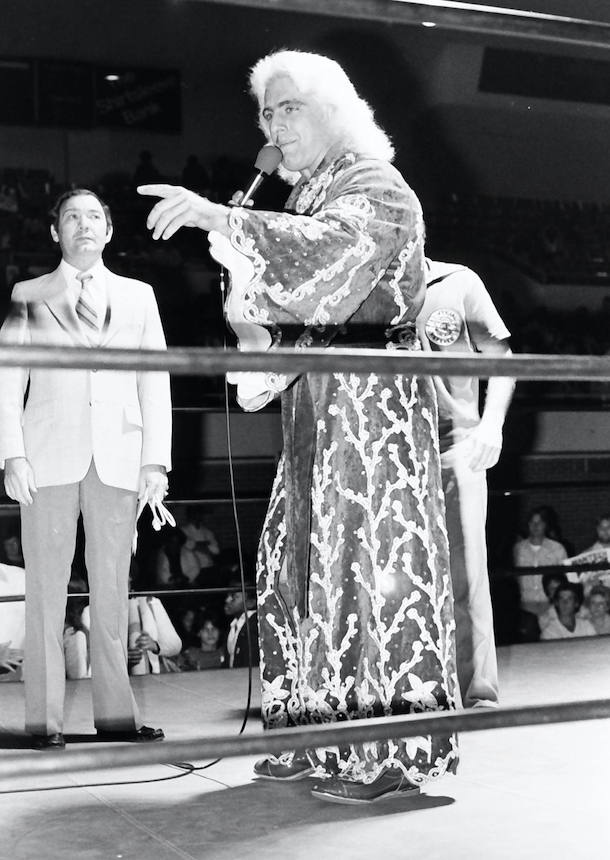
Jimmy Snuka was managed at thetime by the legendary Buddy Rogers, who donned the trunks and wrestled earlier that night with partner Big John Studd.
Behind Flair is NWA referee Tommy Young.
More photos from this night can be seen (and purchased) on the Greenville News website.
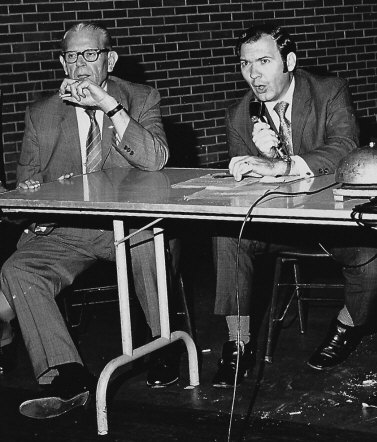 |
| Ring announcer Billy Powell (R) with Greenville promoter Paul Winkhaus |
Back in November of 1978, the student newspaper at Clemson University called "The Tiger" ran an article on Mid-Atlantic Wrestling in the area. The two page spread included discussion of the current popularity of pro wrestling (including an interview with Ric Flair), the skeptics (including the Clemson collegiate wrestling coach), and the fans.
A large photo was included of Ric Flair battling Blackjack Mulligan at the Greenville Memorial Auditorium, less than an hour away from the Clemson campus in Greenville SC. With some examination of the Monday cards that took place in the weeks prior to this article's publication, I've determined that the photo is from their Texas Death Match in Greenville, the main event of the October 23, 1978 card at the Auditorium.
Here is a transcript of the portion of the article that dealt with Billy Powell:
A big part of Monday night wrestling is played by the ring announcer. In Greenville, the announcer is Billy Powell, a well known personality who has gained most of his popularity through the Monday night matches.
"You bet your hat I'm a wrestling fan," Powell said. He has been announcing the matches in Greenville since 1960. "We originally did the TV wrestling here, but the program was moved to Raleigh a few years back," the outgoing Powell stated.
Wrestling in Greenville used to be held in Textile Hall, and that is where Crockett Promotions sanctioned some of their first matches. Crockett operates from its Charlotte base under the sponsorship of the National Wrestling Association (sic). "If the matches are not sanctioned, the NWA will have nothing to do with you," Powell stated.
Concerning the wrestlers as people, Powell said, "They're all nice guys. Did you see Gene Anderson in the ring tonight as he fixed my mic cord? In the ring he is a bad dude, but outside he is just a teddy bear," Powell finished.
Asked if he would ever leave the area, Powell said, "No, because Greenville is my town."

Not only would Powell run down the matches for upcoming card, he would also briefly touch on what happened the previous Monday night, too, tying everything together. He was the man Greenville wrestling fans trusted and was a warm and familiar voice each and every week.
For more on Billy Powell, visit the Billy Powell page on the archived Mid-Atlantic Gateway site, and check all of his related posts on this blog. You can also learn about the history of TV wrestling in Greenville on the WFBC-4 page of our guide to the studio locations for wrestling in the Mid-Atlantic area.
And you can also read the full article on wrestling in Greenville from the Nov. 3, 1978 edition of "The Tiger", which includes an interview with a young Ric Flair, archived here. It's on pages 12 and 13 of the paper, within the downloadable pdf.

Audio: Holiday Greetings from Billy Powell during the beginning of one of his local promos.

The music was an edit from a 1978 European disco hit titled "Got to Have Loving" by French writer/arranger Don Ray (real name Raymond Donnez.) It was the only single from Ray's solo album "The Garden of Love."
The new theme debuted on the February 10, 1979 episode of Mid-Atlantic Championship Wrestling (taped February 7 at WRAL studios in Raleigh.) It played across the same familiar "four square" opening that had debuted back in 1977.
Here is the opening as it played out each week in your living room:
The complete Don Ray track can be found on YouTube (along with the complete album, too.)
That February show also debuted the familiar set that would be used on the Mid-Atlantic tapings through the remaining years at WRAL and then moved and used in modified formation at the smaller WPCQ studio in Charlotte. It was discarded all together when production moved out to the arenas in July 1983.
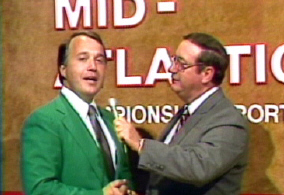
Another big change going forward that began with this show was that introductions for matches would no longer be conducted from inside the ring, but instead by Bob Caudle as he would turn in front of a blue-screen NWA logo. That blue screen allowed a chroma key effect to be used, showing the wrestlers in the ring during their introduction. This set up would be used for the duration of the studio shows, and I've always thought it was a big mistake to make that change. The fans in the studio audience never reacted to Caudle's introductions like they had done over the years for Joe Murnick (or the Murnick boys) because Bob couldn't be easily heard by the fans. Most of the time it made for very flat reactions to the introductions.
The winds of change were blowing with new music, a new set, and a new method for ring introductions, making the taping on February 7, 1979 one for the Mid-Atlantic Wrestling television history books.