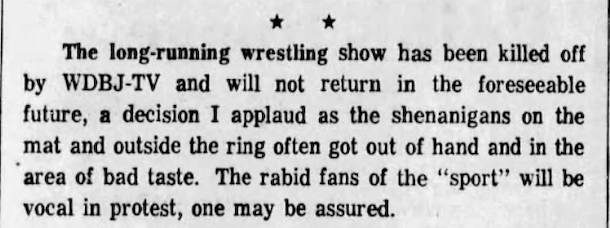
In January of 1967, the popular "All Star Wrestling" show that aired live from WDBJ TV studios in Roanoke, VA, since 1960 was cancelled following an ugly on-air incident between wrestlers Ike Eakins and Luther Lindsey. The cancellation got a small mention by a snarky writer for the Roanoke Times.
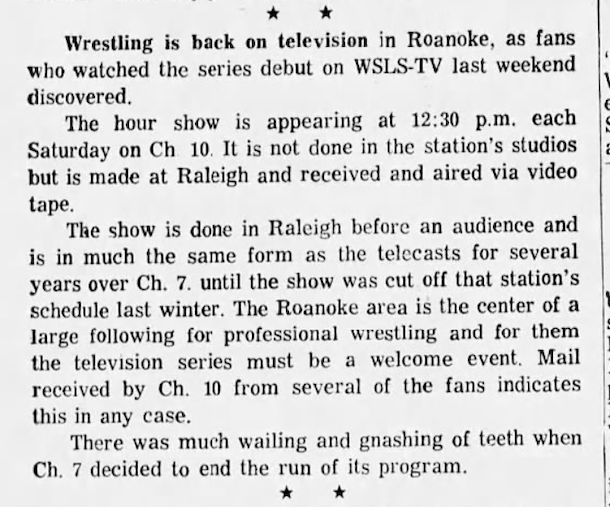
Six months later, promoter Pete Apostolu and Jim Crockett, Sr. were able to get a tape of the Raleigh-produced "All Star Wrestling" (taped at WRAL-5) on another local Roanoke channel WSJS channel 10.
Roanoke had been without wrestling on local TV for roughly six months. Fans were delighted it was back, even if without the familiar voice of former host at WDBJ Hal Grant.
Here are a couple of newspaper clippings mentioning the changes.
WDBJ-7 in Roanoke cancels its long running and wildly popular "Wrestling from Roanoke" program in January 1967 that aired live on late Saturday afternoons since 1960. Some in the local media were happy to see it go. (January 7, 1967)
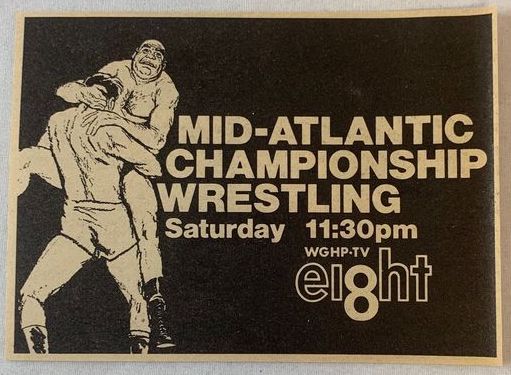
After six long months, fans were delighted when wrestling returned to Roanoke airwaves on WSLS channel 10. "Roanoke Sports Club presents Mid-Atlantic Championship Wrestling" (hosted by Bob Caudle out of Raleigh) aired early Saturday afternoons beginning in July of 1967. Fans missed their local announcer Hal Grant, but soon grew to love Caudle, too. (July 29, 1967)
2012 Mid-Atlantic Gateway Interview with MARK DE CASTRIQUE Early 1970s Director of Championship Wrestling at WBTV-3
Image: markdecastrique.com
In 2012, I had
the good fortune to have an email exchange with Mark de Castrique, an
author and Emmy winning documentary producer who many years ago directed
"Championship Wrestling" at WBTV-3 in Charlotte, NC. In this brief
interview, Mark reflects on those Wednesday nights at the television
studio with Jim Crockett and his crew, including sharing some good
memories of host "Big" Bill Ward as well.
- Dick Bourne, Mid-Atlantic Gateway
* * * * *
Mid-Atlantic Gateway:
Thanks for taking the time to share with us, Mark. While at WBTV, what
was your role there as it pertained to the Championship Wrestling show?
Mark de
Castrique: I was one of the staff
directors who regularly directed the Wednesday night tapings from June
1970 to December 1972. It was a lot of fun. "High drama."
Gateway:
Do you remember in which specific studio you taped wrestling? Mark:
Championship Wrestling was taped in the large studio #2. The ring was
set up by Crockett's people on Wednesday afternoon supervised by an old
retired wrestler named Wally [Dusek] and we taped in the evening.
Gateway: Realizing this was 40 years ago,
do the names of any of the wrestlers from those years stick out in your
mind? Any particular memories about any of the wrestlers or things that
happened during the tapings?
Mark: Some of the wrestlers on the shows I
directed were also ones I had watched on Channel 3 as a kid. Rip (The
Profile) Hawk & Swede Hanson, Johnny Weaver, The Great Bolo, Jerry
Brisco, The Kentuckians, Haystack Calhoun, Homer O'Dell and his
tag-team. Abe Jacobs and his patented Kiwi roll. You remember most
wrestlers had their signature hold that guaranteed victory if they could
just apply it.
Gateway: Did Jim Crockett attend any of
the pre-show production meetings? Do you have any particular memories of
dealing with him?
Mark: Big Jim attended all pre-production
meetings. We would go over the format, I'd make sure I had I.D.
slides for all wrestler introductions. We played it straight. I never
knew who was going to win or what dramatic events would unfold. After
our meeting, Big Jim would meet with the wrestlers in the dressing room.
Big Jim was nice but all business when it came to the show.
Gateway:
What are your memories of "Big" Bill Ward? Did you work with him on any
other shows?
Mark: I only worked with Big Bill Ward on
wrestling. He was easy to get along with and I remember his stock
"action" phrases. "They're fighting like gladiators of old." "It's a
Pier Sixer" (whatever that meant). "He's lower than the belly of a snake
at the bottom of the Mariana Trench" (or bottom of the ocean). Usually
used in reference to the evil manager Homer O'Dell. And, of course, Big
Bill's signature sign off - "Hello to all the shut-ins" and "Be good
sports wherever you go!"
Gateway: Gene Birke, who shared some nice
memories about directing wrestling at WBTV on the website "BT Memories",
has written that some at WBTV didn't like the association with wrestling
and resented the high ratings it got. Would you consider yourself part
of that group?
Mark: I think any resentment toward the
program came from two fronts. WBTV Sports didn't report on the matches
because they didn't consider it a sport. Big Bill Ward referred to them
as Exhibition Matches to handle station concerns regarding their being
represented as a competitive sporting event. The second negative view
came from national advertisers. The program got great ratings, but ad
buyers from New York and other areas outside the region looked down on
it. This was before wrestling mania swept the country through
pay-for-view distribution. Unfortunately, Big Jim didn't live to see the
development of the huge national audience. I considered the production
entertainment and enjoyed watching the antics of the crowd as much as
what was happening in the ring.
Gateway:
What other local shows did you direct besides Championship Wrestling?
Mark:Newscasts, Betty Feezor, Pat Lee Show, Country Style Roundup with
future congressman Bill Hefner, Tommy Faile Show, Fred Kirby Show, and
various special projects.
Gateway: You are a successful author now.
How long after you left WBTV did you stay in the TV production business,
and at what other stations? Were you ever involved with directing or
producing wrestling at another station?
Mark: I am still in the TV production
business. I left WBTV at the end of 1972 and worked for over four years
as a director at the ABC affiliate in Washington, D.C. We didn't have
wrestling. We had Congress and Watergate. I'd prefer wrestling where the
good guys and bad guys were easier to spot. I returned to WBTV as
manager of their creative department and then program director. I left
in 1984 as a partner in a production company. In addition to writing my
mystery/thriller novels, I do documentary and corporate video
production. I feel fortunate to have been a part of local television
when the stations did a variety of programs and were a reflection of all
aspects of their communities.
Gateway: Mark, thanks so much for your time and walking down memory lane with us. This will be of great interest to folks who visit the Mid-Atlantic Gateway.
Mark de Castrique is the
author of several novels including his latest mystery/thriller "The
13th Target." He is a veteran of the broadcast and film production
business and has received an Emmy Award for his documentary film work.
He also has a pretty good memory when it comes to early 1970s
pro-wrestling, and I appreciate him sharing some of those memories with
us.
8/26/12 - Mark posted a link to this interview on his Facebook page, and there was some discussion there with his friends, including a question about any memories of audience regulars at the wrestling tapings, which elicited this funny response: "Tickets were in high demand and no one came week to week. Mostly church groups. I always thought it odd churches came to watch guys pulverize each other."
8/27/12 - Mark mentioned on Facebook that a secret of his past had been revealed with the Gateway interview. But we didn't out him; Mark had earlier mentioned his connection with pro wrestling in a 2010 interview with the Salisbury (NC) Post. From the article: Now based in Charlotte, de Castrique moved here in the 1970s and had a broadcast career with local TV stations. "This was before the days of cable. Local stations did everything. ... I once directed professional wrestling, did an entertainment show ..." From "Writer Goes from Broadcast to Book" - SalisburyPress.com.
Originally published August 23, 2012 on the Mid-Atlantic Gateway.
Legendary Joe McHugh introduces "Nature Boy" Buddy Rogers
I have a fondness for many of the old-school ring announcers. They all had a a certain flair for the dramatic, and made the introduction of any match seem special. The art of classic ring announcing went the way of the old smoke filled rooms that were the classic old venues in pro-wrestling.
One of my favorites might surprise you; the great Joe McHugh of the old W.W.W.F.
McHugh was a wrestling and boxing announcer going back to the 1950s, most famously with wrestling fans at the W.W.W.F. television tapings at Allentown, Pennsylvania's Agricultural Hall. When I first saw WWF "Championship Wrestling" on WOR-9 out of Secaucus, NJ in around 1981, I thought to myself, "Now THAT is a ring announcer."
This is an audio clip of McHugh introducing "Nature Boy" Buddy Rogers at
the Philadelphia Spectrum in the mid-1980s. I loved the way McHugh included the
historical mention of Rogers being the only man (at that time) to have
held both the NWA and WWF world titles. Those details mattered, and
meant something to fans in that era.
The audio of that introduction is included here:
I always thought Joe McHugh and Raleigh's Joe Murnick (my favorite ring announcer of them all) were kindred spirits, at least in their ring announcing style, and both with accents of speech that clearly demonstrated from where in the country they hailed. They are both at the very top of my list.
(Edited from a post originally published January 2018 on the Mid-Atlantic Gateway.)
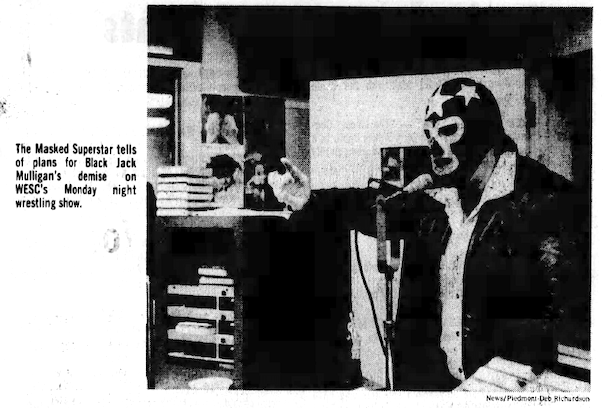
Greenville News (Greenville SC) May 14, 1978 Article by Deb Richardson Clippings from the collection of Mark Eastridge
"The Wrestling Show" aired on WESC FM in Greenville, SC at midnight on Monday nights after the weekly matches in the Greenville Memorial Auditorium. This was in the mid to late 70's. WESC midnight-to-6:00 am DJ Fred Nabors was the host.
Fred Neighbors (center) with Ric Flair and Greg Valentine
Sandy Scott, Crockett's local promoter at the time, was in studio also. They would have the results from the night's event, play taped interviews from earlier the same night that Fred Nabors would conduct before the matches and tape them for play on the show. Usually, they would get some of the guys to stay in town and go live on the air during the show.
Ric Flair, Greg Valentine, Sandy Scott
A fellow named Jim McNerney lived in Greenville and was trying to break into writing for the wrestling magazines. He persuaded Fred Nabors to let him come in the studios that night and take these pictures.
In the late 1970s, Roanoke promoter Pete Apostolou tagged a little promotional audio segment onto the end of the Mid-Atlantic Championship Wrestling program that aired on WSLS-10 in the greater Roanoke market. Apostolou was the local promoter for Jim Crockett Promotions. His own promotional company was called The Roanoke Sports Club.
After Bob Caudle would preview the matches for next week's show, you would hear the following:
"Mid-Atlantic Wrestling has been a presentation of WSLS TV-10 in association with the Roanoke Sports Club. Join us next Saturday afternoon for Mid-Atlantic Wrestling!
For complete information about sponsorship of wrestling matches in your area, contact the Roanoke Sports Club, Post Office Box 1855, Roanoke, Virginia, 24008."
This of course was only heard on the Roanoke version of Mid-Atlantic Wrestling, but was indicative of Apotolou's additional efforts to promote his towns in the Roanoke area, that included Lynchburg and other spot show towns.
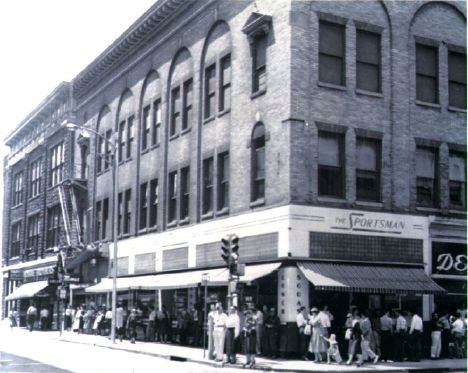
Apostolou's headquarters for the Roanoke Sports Club was the Sportsman in downtown Roanoke, where advance tickets were always available for Aposolou's JCP wrestling programs at both the Civic Center and the famous Starland Arena.
When I first got "hooked" on Mid-Atlantic Wrestling, one of the things (other than the great wrestling) that I liked most about both Crockett shows was the great theme music.
I'm not talking about wrestler's theme music. This was in 1975 and almost a decade before every wrestler had their own theme music.
I'm talking about the opening theme music that started off each show. It was a signature element of each of the two programs that Jim Crockett Promotion produced, and is today as much of the sentimental or nostalgic aspect of those shows. That's something long ago lost as it regards pro-wrestling on TV today.
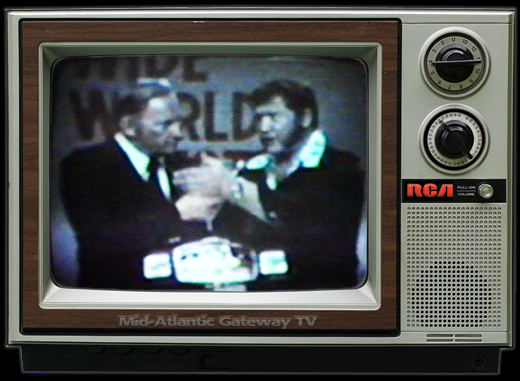
Ed Capral with NWA champion Harley Race on the set of "Wide World Wrestling" in 1977
Over the many years, I've enjoyed collecting theme music from the various wrestling shows I watched in the 1970s and 1980s. Some used edited versions of popular commercial music, some used "production" music written especially for that use.
My favorite wrestling TV-show theme of them all was the music for "Wide World Wrestling" in 1975-1978. "Wide World Wrestling" was Jim Crockett's "B" show. If a TV market only featured one of Crockett's TV shows, it would always be the "Mid-Atlantic Championship Wrestling" show, which was the "A" show. If a traditional Crockett TV market featured both Crockett shows, then "Wide World" would be added as the second show in that market, or the "B" show.
The show began in October of 1975 and was hosted by longtime Atlanta wrestling broadcaster Ed Capral. When Capral left in 1977, he was succeeded by hosts Russ Dubuc and then the duo of booker George Scott and Tom Miller. In 1978, Crockett changed the name of the program to "World Wide Wrestling" as host Rich Landrum took over the show, and by the early 1980s, this was the show that started going into Crockett's expansion markets, as well as remaining the "B" show in Crockett's home markets.
"Truckin'" Tom Miller, host of "Wide World Wrestling" for roughly 6 months in 1978
The opening theme music for this show was awesome! The opening video package that ran under the music was a quick montage of various wrestlers doing various wrestling maneuvers that flew by at quick pace that matched the upbeat tempo of the music. The music and video open had sort of a "Wide World of Sports" feel to it. ABC's "Wide World of Sports" was one of the most popular sports programs of the era and as much a part of Saturday afternoons as wrestling was in that era.
Recently our friend Craig at Wrestling Media (wrestlingmedia.ws) was kind enough to send us the original recording of the music used for "Wide World Wrestling." I got his very nice email on Thanksgiving Day - - what a wonderful gift on Thanksgiving! I was thankful indeed for his generosity and for remembering at all that this was something I had been looking for for years. He was able to identify it solely by the low-resolution recording I had of it on the Mid-Atlantic Gateway Archive site.
The music, titled "Diamond Head" was written and recorded by Walter Murphy, who had a #1 pop hit back in 1976 called "A Fifth of Beethoven." Murphy has an extensive resume of production music and there are several vinyl recordings of his still floating around. The album that has "Diamond Head" was titled "Major Production Music", Vinyl 6088 on Major Records (now known as Valentino.) It is track 3 on side B of the record and was recorded and released in 1975 (the same year "Wide World Wrestling" debuted.
The "Wide World Wrestling" theme was created by taking various segments of the original 1:30 recording and piecing them together to make the final 25 sec. version you heard each week to open the show. The tempo of the wrestling version was also a little faster than the original, although at the same pitch.
I took Murphy's original recording and edited a version together that is nearly identical (in arrangement and speed) to the classic 1975 wrestling theme, and happily present it here.
There are no known video recordings of the 1975-1978 "Wide World Wrestling" show, which is a very sad thing. The theme hasn't been heard in this arrangement since 1978, so only fans who are roughly in their mid-40s or later would even remember it. But for those that watched "Wide World Wrestling" every single weekend without fail as I did each week, this will be a wonderful trip down memory lane and a nostalgic reminder of a great era in Mid-Atlantic Wrestling. And for those hearing it for the first time, this is what a real wrestling theme sounds like.
Thanks to Craig at Wrestling Media (wrestlingmedia.ws) for his forwarding this information and for providing me the original track that resulted in my favorite wrestling theme music of them all.
Originally published December 2016 on the Mid-Atlantic Gateway.




 Gateway:
What are your memories of "Big" Bill Ward? Did you work with him on any
other shows?
Gateway:
What are your memories of "Big" Bill Ward? Did you work with him on any
other shows?






:format(jpeg):mode_rgb():quality(40)/discogs-images/R-3544026-1335781394.jpeg.jpg)
