Showing posts with label WRAL-5 Raleigh. Show all posts

Wednesday, February 5, 2025

Crockett TV Broadcast Map 1960


This information flyer was apparently given to local event promoters throughout the Carolinas and Virginia in hopes of JCP to expand their "spot shows" in the region. It touted the burgeoning television presence of Jim Crockett Promotions professional wrestling television shows that would help these promoters build their gates. The local promoters would book their talent from Jim Crockett out of Charlotte.

At the point in time this graphic was published (late 1959 or very early 1960), Crockett had live TV already being taped and aired in Charlotte, Raleigh, and Roanoke, with High Point NC and Greenville SC soon to follow. What isn't clear is if Crockett hoped to have additional live or live-to-tape locations at the other stations listed on this flyer, or if they were to simply carry a tape from one of the other live shows.  

Some notes on the television stations featured here:

WBTV Charlotte NC
Jim Crockett began airing live wrestling on Channel 3 in Charlotte in January of 1958. The program, called simply "Championship Wrestling" was live at first and later would be taped and aired on a slight delay.

WFBC Greenville SC
Channel 4 in Greenville actually began airing live wrestling from its studio in 1956, nearly a year and a half before WBTV did in Charlotte. That first foray lasted only 3 months. It appears it was the very first television for Jim Crockett Promotions wrestling.  WFBC's second attempt at live wrestling came in March of 1960, just a month later than this graphic indicates the start date would be for TV wrestling in Greenville. That second stint of live studio wrestling ended in December 1961. At that point, WFBC began carrying the tape from Raleigh.  

WRAL Raleigh NC
Channel 4 in Raleigh began airing its own live studio wrestling in January of 1959, one year after the WBTV tapings began. Most other TV stations in the growing JCP network carried the tape from Raleigh, titled "All Star Wrestling." Fourteen years later, WRAL would be the site where all JCP televison production would be consolidated. 

WDBJ Roanoke VA
Channel 7 in Roanoke began airing live wrestling from its studio in 1960, where it lasted for local promoter Pete Aposolou for seven years, when they began carrying the Raleigh tape.

WFMY Greensboro NC
While live wrestling may have been planned for WFMY channel 2 in Greensboro in June of 1960, it appears it never came to fruition. In fact, it appears WFMY never carried a Crockett tape at any point. (We welcome new information.) Another TV station in that same DMA market, WGHP channel 8 out of High Point, began airing its own live-to-tape studio wrestling for Jim Crockett in February of 1964. That lasted until the great consolidation to Raleigh in 1974.

Richmond VA
At the time of this information flyer, it seems clear JCP wanted to have a live TV presence in Richmond, similar to WBTV or WRAL, to support the work of long time Richmond promoter Bill Lewis, now working with Jim Crockett in Charlotte. No doubt Lewis was working to secure an arrangement with a station there, but it never happened. Lewis died in 1961. WTVR channel 6 eventually became the station that would carry the wrestling tape from Raleigh NC on its airwaves for decades. By that point, both Raleigh and Richmond were promoted by Raleigh promoter Joe Murnick, working for Jim Crockett.

WNCT Greenville NC
WECT Wilmington NC

Apparently both of these stations were to begin carrying a tape from JCP in 1960, with the tentative date being that June. By the 1970s though neither station would be carrying a Crockett tape. The Wilmington station would eventually be carrying the Championship Wrestling from Florida show. More information is needed on these two stations listed here.

We are also looking for information on Jack Partlow and Hal Van Horn listed as contacts in Charlotte on this information flyer.  

Thanks to Scott Teal for originally sending this image to us.  


HOME MID-ATLANTIC BOOK STORE  |  STUDIO DIRECTORY
ABOUT  |  CONTACT  |  MID-ATLANTIC GATEWAY


Visit the DESKTOP VERSION of the website for lots of FILTER OPTIONS to find info on your favorite announcer or studio location.  Filter options are located on the right side of the web/desktop version of the website. 

Sunday, August 11, 2024

TV Wrestling in Charlotte a Big Success (1978)

Fresh off my post about the monster TV ratings for JCP in Charleston, SC in 1978, here is another article about the strength of Crockett programing in that same year, this time in Charlotte, NC.
 

PRO WRESTLING ENDURES,
PROSPERS WEEKLY ON TV

By Mark Wolf
The Charlotte Observer, March 25, 1978


Crunch. Slam. Piledrive. Thud. Smack. Kick. “You turkey neck.” Sleeper. Pin.

Professional wrestling is on the air.

The cast changes, heroes and villains arrive and depart, the belts, symbolic of myriad championships, change hands and the sport itself is given the back of the sports establishment’s hand. But televised professional wrestling endures; no, it prospers.


Consider. Except for local news, "Mid-Atlantic Championship Wrestling" is the longest running show on Charlotte’s Channel 3 (WBTV). “It’s been on at least close to 20 years,” says John Edgerton, WBTV managing director. “I’ve been here since 1957 and I can’t remember when it started. The records probably don’t go back that far.” (Mid-Atlantic Gateway Note: it was Jan. 11th, 1958).

The one-hour show, which airs Saturday afternoon on Channel 3 (the time varies) was watched in 63,000 households during a recent ratings period. A similar show, Wide World Wrestling, is shown at noon Saturdays on Channel 36 (WRET) and drew 43,000 households in the same period.


“It probably enjoys the longest continuing run of any program on television,” says WRET station manager, Dave Uhrich. “I can’t think of any other syndicated show that’s been on that long except maybe some religious show.”

Charlotte promoter Jim Crockett produces and packages both programs and provides them free to the Charlotte stations and 22 other stations in North and South Carolina and Virginia. Crockett gives the show away in return for commercial time during the broadcasts to promote the live wrestling shows he stages in the three states. He also sells the show to stations in West Virginia, Georgia, Texas, Florida, Pennsylvania, Michigan and Kansas.

The wrestling show is an everybody wins situation. Crockett gets an hour’s promotion for his arena shows, and the stations get not only free programming, but can sell commercials during the show.

“Because television is seasonal, there are not commercials in all of the slots that are available,” says WBTV program director John Hutchinson. “Actually, we have movies we could make more money from, but we have a need for a wrestling program. The ratings are very good. If we weren’t getting that particular show, we would go out and look for another one.”

“It (wrestling) appeals to so many different levels. The nostalgia of people who watched it when they were kids, the morality play element of good against bad, the football fan who likes to sit in his armchair and work out his aggressions, older people, kids, it cuts across all strata. With everything else changing in society, wrestling has always been popular on TV. There’s something going on there, something that taps a need in a lot of different people.”

According to Crockett, the show outdraws Wide World of Sports, NCAA Football and NCAA Basketball. “In Greenville, SC, we delivered more adult males than ‘Starsky and Hutch’ or ‘Kojak’, and they’re in prime time.”

Crockett’s shows, produced before a live audience every Wednesday night in the Raleigh studios of WRAL-TV, are technically proficient and include slow-motion replays of winning maneuvers. (“Let’s have another look at that figure four leglock, Bob.”)

Bob Caudle

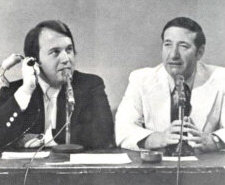
Bob Caudle, now a WRAL salesman, formerly an on-air personality, and Crockett’s brother, David, announce the Mid-Atlantic (Channel 3) program. Former wrestler George Scott hosts the Wide World (Channel 36) version with a guest commentator – usually a wrestler, but occasionally Jim Crockett. (“Boy, do I hate doing that,” says Crockett.)

The same corps of wrestlers appear on each show. The format includes four or five matches interspersed with interviews. The interviews afford the wrestlers an opportunity to develop their personalities, bad-mouth upcoming opponents, and hype the next live show. Interviews promoting matches in each market area are spliced into the tape which goes to the station in that market. 

Generally, a headline wrestler (Ric Flair, Greg Valentine, Wahoo McDaniel, Ricky Steamboat, or the like) opposes a lesser light. Occasionally, though, Crockett matches a pair of headliners. Recently, Valentine captured the Mid-Atlantic championship from McDaniel on TV and broke Wahoo’s leg in the process.
Whether wrestling is real, semi-real or a complete sham is beside the point (says Crockett). “I don’t believe anybody has ever been able to go to one of our matches and walk away and say it’s fake.”

At its best, wrestling is akin to a superb magic act. It works to the extent that the audience wants it to. 

Just like the old Mets slogan, “You’ve gotta believe.”


HOME  |  MID-ATLANTIC BOOK STORE  |  STUDIO DIRECTORY
ABOUT  |  CONTACT  |  MID-ATLANTIC GATEWAY  |  DOMED GLOBE

Visit the DESKTOP VERSION of the website for tons of FILTER OPTIONS to find info on your favorite announcer or studio location.  Filter options are located on the right side of the web/desktop version of the website. 

Tuesday, June 18, 2024

A Belt for a Champion

If there was ever a true champion for wrestling fans, especially in the Carolinas and Virginia, it was Bob Caudle.  And a champion needs a belt.

Bob Caudle with his own title belt, a gift from the Mid-Atlantic Gateway, at his home in Raleigh, NC.

Originally published on the Mid-Atlantic Gateway.

One of the things that I've always felt made Bob Caudle so special to wrestling fans from several generations is the fact that he was the steady constant on our televisions every week for near 34 years. The wrestlers came and went, but Bob was the constant. Almost every single week from when he took over for Ray Reeve at WRAL in Raleigh on All Star Wrestling in 1961 to the last days of Smokey Mountain Wrestling in the 1990s, Bob was the constant. 

He is best remembered as the voice of Mid-Atlantic Wrestling throughout the 1970s and 1980s. His friendly smile and welcoming voice was a warm embrace every Saturday afternoon, and the relationship he established with fans transcended that time to where even well into the 2010s, Bob was attending fan conventions and received warmly by fans. 

If there was ever a true champion for wrestling fans, especially in the Carolinas and Virginia, it was Bob Caudle. And a champion needs a belt.

The belt on display at my home before making the trip to Raleigh. Also in this photograph are Bob's Hall of Heroes plaque which he gave to me on my 50th birthday (and I treasure), as well as the photograph used for the main plate of the belt.
 

The Mid-Atlantic Gateway presented Bob with a special, one of a kind, commemorative belt paying tribute to the Voice of Mid-Atlantic Wrestling. It was presented to him and his wife Jackie on June 17, 2024 at his home in Raleigh. 


I wasn't sure how Bob would receive it. While he loves reminiscing about the "old days," he generally is not at all interested in holding on to wrestling memorabilia. Soon to be 94 years old, and in a no-holds-bar match against the ravages of father-time, Bob said it will be a tough task for anyone to take this title away from him. "They will bury me with this!" he said with a big smile. 

It was a nice moment with a truly wonderful man.

- D. Bourne 

See All Posts that feature Bob Caudle

HOME MID-ATLANTIC BOOK STORE  |  STUDIO DIRECTORY
ABOUT  |  CONTACT  |  MID-ATLANTIC GATEWAY

Tuesday, June 4, 2024

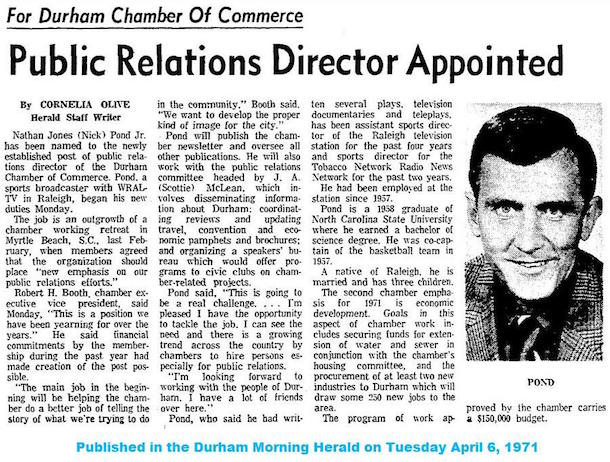
Nick Pond Leaves WRAL and "Championship Wrestling" (1971)


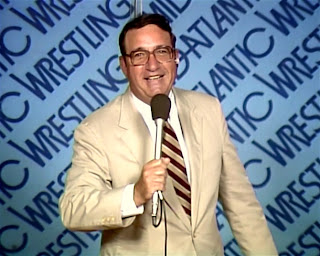
WRAL News personality Nick Pond hosted the Raleigh-only version of the Jim Crockett Promotions wrestling show known simply as Championship Wrestling in the 1960s and very early 1970s. 

Pond left WRAL at the end of March, 1971 to become the public relations director of the Durham Chamber of Commerce. He stayed with that job until August, 1973. He returned to WRAL shortly thereafter as a news anchor, but never called wrestling again.

During at least part of the time (and perhaps the whole time) Pond was working at the Durham Chamber, Elliot Murnick (son of Raleigh area promoter Joe Murnick) hosted the version of the Mid-Atlantic show that was exclusive to the Raleigh market. 

Soon after, the dual-tapings ended, and Crockett began taping two different versions of Mid-Atlantic Championship Wrestling. The first, hosted by Bob Caudle (who had hosted the syndicated All Star Wrestling for over a decade), was the "A" show that went to all Crockett TV markets. The second, the "B" show hosted by Les Thatcher, went to markets where JCP was able to barter both shows. Usually (but not always) the  second "B" show aired on a different station in that market.

Clipping courtesy of Carroll Hall.

HOME MID-ATLANTIC BOOK STORE  |  STUDIO DIRECTORY
ABOUT  |  CONTACT  |  MID-ATLANTIC GATEWAY

Visit the DESKTOP VERSION of the website for tons of FILTER OPTIONS to find info on your favorite announcer or studio location.  Filter options are located on the right side of the web/desktop version of the website. 

Sunday, May 26, 2024

Wrestling's Success on Charleston Television (1978)

Wrestling Audience Greatly Expanded by TV Saturday
By Bob Gillespie, Charleston Post & Courier, September 23, 1978

TV wrestling – a success story? Go ahead. Laugh. That’s just what both the pro wrestling promoters and local television stations are doing, all the way to the proverbial bank.


For several months now, I’ve followed this TV sports column and I have yet to see anything written on what has to be the tube’s most successful enterprise in the realm of sports. I shall now try to correct this omission.

What am I talking about? Football? Basketball? Women’s field hockey? Tournament-level tiddlywinks? “No” to all the above.

Try professional wrestling.

http://
 

"Wrestling?" you ask, looking down your cultured nose with disdain. That Roman gladiator spectacle of the masses, with costumed clowns flying through the air like so many comic book characters? TV wrestling – a success story? Surely I jest, you say. And you probably laugh.

Go ahead. Laugh. That’s just what both the pro wrestling promoters and local television stations are doing, all the way to the proverbial bank.

The fact is, wrestling, especially on television, has been growing in popularity over the last few years – by leaps and bounds greater than any you’ll see in the ring. And no one realizes – and appreciates – that fact more than Charleston area television management.

On any given Saturday, year round, the Charleston viewer can see wrestling twice in one day. That’s if he doesn’t have cable TV. If he does, add another show on Saturday and one on Sunday. And if you live far enough toward Savannah where you can pick up that city’s television, you can catch two more showings, or five more programs per Saturday.

There’s a reason that pro wrestling is on so often: it’s popular.

“The shows are rather popular in this area, I know that,” says WCIV-TV (Channel 4) Program Director Don Moody. “If we have to move the show (1 pm Saturday) for a network thing, we really get the phone calls.”

Program Director Jim Shumaker of WCBD-TV (Channel 2), whose station carries wrestling Saturday night at 11:45, is even more emphatic. “It’s just unbelievable,” he said. “It leads its time period against all comers. People in this area are really hung up on this wrestling.”

How hung up? “In the last important ratings book, which was back in May, wrestling at midnight Saturday was pulling a 52 percent share of the audience,” Shumaker said. By comparison, Saturday Night Live on NBC (Channel 4) gets 32 percent, while Channel 5 (WSCS-TV), carrying Blockbuster Theatre, takes a 21 percent share.”


Channel 2 isn’t the only beneficiary of wrestling, either. When Channel 4 runs wrestling at 1 pm, it gathers in 46 percent shares of the audience at that time, as opposed to 31 percent for Soul Train (Channel 5) and 19 percent for American Bandstand (Channel 2). “They’re obviously doing something right,” added Shumaker.

“They” in this case is an outfit called Jim Crockett Promotions out of Charlotte, NC, who provides their Mid-Atlantic Championship Wrestling in the Carolinas/Virginia areas. Crockett not only handles the live events at local arenas, such as Charleston’s County Hall operation on Friday nights, but also produces the television shows, filming them weekly at WRAL-TV in Raleigh, NC.

The most ironic thing about the whole operation is the deal between Mid-Atlantic Championship Wrestling and the local television stations. The stations get a program with a high rating – virtually for free.

“Crockett supplies us with the taped program,” Shumaker said. “We give them two one-minute-40-second commercials for promotion of their local wrestling matches. We get the program, which leads its time slot, plus 10 minutes of commercial time to sell. And they’re easy to sell, too.”

Why give away a program when stations that run movies or even network programs against the wrestling - and still lose out – are paying big bucks for those time-fillers? Henry Marcus, who promotes wrestling for the Crockett operation in this area from his Columbia base, has an answer.

“It’s simple,” said Marcus, who started wrestling promotion in 1934. “Television is great, whether you’re selling wrestling or tooth paste. It’s the greatest advertising device man has ever invented. When you can have 75 million people watch the Ali-Spinks fight, you can’t beat it.”

The Crockett TV blitz started “about 18 years ago under Jim Crockett, Sr., the father of the Jim Crockett who runs the operation now,” said Canadian native, Sandy Scott, himself a former popular wrestler who now promotes the Mid-Atlantic product in Roanoke, VA, after covering the Greenville area the last three years. “The first station was Channel 7 in Roanoke in 1950 or so, and the second was WFBC-TV in Greenville.”

Scott, like most people involved in TV wrestling, is at something of a loss to explain its popularity. “I don’t know for sure, but it’s tremendous. Of course, we feel we offer the top wrestling talent, and the best will always hold the audience.”

“Wrestling did well without television, but TV has expanded the number of people we reach,” he added. “Folks in smaller towns see it now.”

The only thing that may be holding pro wrestling back now is the item referred to at the beginning of this piece: its image. Sportswriters and some sports fans deride pro wrestling, question its status as legitimate sport. That’s actually putting it mildly; wrestling is often called a fake, a circus, a joke and the like.

I’m not getting into the merits of such arguments. I like my skin in one piece, thank you. As one local television sportscaster put it, “I used to call wrestling a phony, but I learned you don’t do that in a crowded bar.” But the arguments against wrestling still exist.

If the arguments don’t seem likely to change, though, the image may be doing so. “The wrestling programs on TV draw all spectrums,” Channel 2’s Shumaker noted. “We sell it locally, but our national salesmen say the general feeling among the big sponsors is that wrestling appeals to the ‘blue collar and beer’ crowd.”

“That’s not necessarily so. It seems to be drawing more young people, but it gets men, women and children, all ages. They seem to be expanding the market.”

For sure. Said Marcus, “Our TV survey man in Charlotte estimated that on any Saturday, some 1.1 million people are watching wrestling on stations in the Carolinas and Virginia.” “Blue collars and beer” or not, that’s a heap of potential customers for the TV sponsors.

So whether you love wrestling, hate wrestling, or just don’t care, you’ll keep on seeing it on the tube for a long time. “We tend to take it for granted that it’s going to capture its time slot,” Shumaker said. “I guess you’d have to call it a success story.”

And television is not inclined to give up success stories.

*********************************
Photos and graphics were added by the Mid-Atlantic Gateway, and were not part of the original article.

HOME MID-ATLANTIC BOOK STORE  |  STUDIO DIRECTORY
ABOUT  |  CONTACT  |  MID-ATLANTIC GATEWAY

Visit the DESKTOP VERSION of the website for tons of FILTER OPTIONS to find info on your favorite announcer or studio location.  Filter options are located on the right side of the web/desktop version of the website. 

Tuesday, May 21, 2024

Les Thatcher: Studio Promo Tapings at WRAL in the 1970s

Conversations with Les Thatcher:
Local Promo Tapings for Jim Crockett Promotions (1970s) at WRAL
Originally published on the Mid-Atlantic Gateway

From 1974 - 1977, Les Thatcher hosted and conducted the local promos that were inserted into each Mid-Atlantic and Wide World Wrestling show for each local market. The shows were taped at WRAL TV studios in Raleigh, NC. We talked with Les about how and when those promos were done, offering interesting insight to the making of Mid-Atlantic Championship Wrestling on television.

*********************************


Les Thatcher

Dick Bourne: The tapings in Raleigh were on a Wednesday night, I remember. Did you do the local spot promos before the tapings?

Les Thatcher: Yes. What we did, we usually started about noon, and we used to average over a hundred spots a Wednesday afternoon.

DB: I can believe it, given the number of markets.

LT: That show was in 30-some markets and we had two 2:20 spots per show, plus some of the 30 second promos we cut to go into some of those markets, too. And then occasionally some of the boys might be booked out to Eddie Graham or down to Atlanta, so we’d cut promos to ship out to them. Of course, as antiquated as it all sounds now, back then it worked. I would go into the (Charlotte) office on Monday and George Scott would give me the line-ups, start times, buildings, towns, and so forth. I had an office in the (wrestling) office, but I also had an office at home, They didn’t much care where I worked as long as I got the stuff done. But I would take that old yellow newsroom-type paper, perforated paper that would fold; Jimmy (Crockett) bought that for me by the box. It would fold easy, and I would take a grease pencil and I would write, for example, Friday Night, June the 6th, Richmond, Virginia, the Coliseum, bell time, whatever, and then I would list a few stars, and then one or two matches and the stipulations. And we often would plug three towns off of the same TV. Those were my cues. Nothing was written out for me, there were no teleprompters, no cue cards.

DB: I always wondered if someone was holding cue cards.

LT: Well, Danny Miller helped out with it. Gene Anderson was working in the office at the time, he helped out with it. George Scott himself would help. What they did was take my folded stack of paper and tape them to the top of a music stand, because the post on the music stand was adjustable, and they would make it just high enough that it would fit right under the camera lens. So let’s say, Flair and I are finishing up the last 2:20 on the Richmond tape, and I’ve got that music stand with the Richmond info sitting in front of me; Ric’s on my left, and he’s doing his pitch. And we had a back timer, like photographers use, and that’s how we kept our time. And that was on a stand sitting right there, too. So anyway, we’d wrap up that 2:20 for Richmond, he would step off to the left, Gene or George or Danny or whoever would change the music stand, and now we’ve got the first 2:20 for Raleigh, for example. And then here comes Blackjack in on my right. And we’d hit that 2:20, and then for the same show we’d do the 2:20 (with Blackjack’s opponent) in on the other side . . .

DB: So you would do each city’s promos back to back, babyfaces and then heels?

http://
Les Thatcher and Bob Caudle (1974)

 HOME  |  MID-ATLANTIC BOOK STORE  |  STUDIO DIRECTORY
ABOUT  |  CONTACT  |  MID-ATLANTIC GATEWAY  |  DOMED GLOBE


LT: Yes, and I got off of that set for two reasons and two reasons only: to go to the bathroom or to grab a quick bite to eat. That was probably the first place I worked where they catered anything in because we were there so long. Now days, it’s standard procedure in both TV companies to have food catered in. But back then, they’d bring in Col. Sanders for us. And also, as well as I was dressed (for the TV), I finally succumbed to crape-soled work shoes because I was standing on that concrete so much.

DB: And your shoes never showed on TV . . .

LT: Exactly. So once I was aware of that, I said, hell I’m driving myself crazy wearing these shoes. We would start at noon and sometimes it was 5 o’clock before we were finished.

DB: I don’t see how your voice held out.

LT: I’m not sure, either, to tell you the truth, Dick. And the funny thing is, I got that 2:20 in my head, you’re doing a hundred of these every Wednesday. But there were times that someone would step on the plug of that back timer, or for whatever reason it would stop, I would keep the interview going, and I swear to you, I could finish it within a couple of seconds one way or the other of the exact time, because I had done them so many times. And then I go to Knoxville and do my spots up there (for Southeastern Championship Wrestling.)

DB: I guess you just get in a rhythm.

LT:  Exactly. My schedule, when I was doing both shows between November of 1974 and February or March of 1978, before I moved to Knoxville, I would, as I said, go in (to the Charlotte office) and get the stuff from George (Scott) on Monday. I was helping with the magazine, and the TV in Charlotte, plus I was wrestling a couple of nights a week, and then we’d go to a show on Tuesday, and then drive up from Charlotte early that Wednesday morning, did promos from noon to 5 o’clock, grabbed a bite to eat, I was hosting the one show, Bob Caudle was hosting the other. And then once I started doing the Knoxville show, I think Jimmy was afraid people would see Les on two shows in the same market, and that’s basically when Ed Capral came in.

DB: That must have been in 1975 or 1976, because when I first discovered Wide World Wrestling on channel 13 in Asheville, Ed Capral was the host. I never knew you hosted one of the (Mid-Atlantic) shows until I read it on your site. We didn't get the second Mid-Atlantic show where I grew up.

LT: You mentioned channel 13 in Asheville earlier; do you know in that three-station market what our share or percentage of homes tuned in to that show was?

DB: I remember knowing that it was huge . . .

LT: Between 70-80%.

DB: Good grief! 

LT: Yep, when our show was on the air in that three station market, our show was watched by between 70 and 80 percent of the homes available to those three stations.

DB: Unbelievable.

LT: Another guy in the Crockett office, who wasn’t involved in the wrestling, we put together a promotional packet, laid out the design for the little cover and all that, and in there we had a sampling of the different markets we were in and what kind of shares and numbers we pulled there. That’s how I remember the Asheville thing so vividly. So when people think wrestling’s popularity started with Hulk Hogan, it just drives me crazy. But anyway, we’d do the TV in Raleigh on Wednesday, and then Thursday, I’d wrestle for Crockett someplace, then Friday morning, I would get on Piedmont Airlines, remember them?

DB: I certainly do. My Dad flew them every week for awhile.

LT: I would get on a Piedmont flight in Charlotte that hopped into Greenville/Spartanburg, then into Asheville, and it finally got me to Knoxville. Ron (Fuller) would pick me up at the airport, we’d do lunch, go to his house, we’d lay out the TV, I helped him with the booking along with Nelson Royal, then we’d work Knoxville Friday night, and then do TV Saturday morning, work a house show some place Saturday night and I’d get back on the bird Sunday morning, and I’d do it all over again.

*******************************************  

Special thanks to Les Thatcher for his insights on the studio promo tapings at WRAL. [GATEWAY]

Les educated us on the promo tapings in the 1970s. Jim Cornette shared some amazing information on one of his podcasts about the Crockett studio promo tapings in ther 1980s, at the make-shift TV studio in the garage at Briarbend Drive:

Jim Cornette Explains All About the TV Distribution Process for JCP in the 1980s

*********************************

In 1974-1975, Les Thatcher and Bob Caudle both hosted a separate hour of Mid-Atlantic Championship Wrestling taped at the studios of WRAL in Raleigh NC. Bob's show was the primary show (or "A" show) and aired in all Mid-Atlantic markets. Les's "B" show aired in select markets that supported a second hour of JCP wrestling, and usually on a different station on those markets.

For example, in the Greenville/Asheville/Spartanburg market, the Caudle show aired on WFBC-TV channel 4, the NBC affiliate out of Greenville SC at 1:00 PM on Saturday afternoons. Thatcher's show aired at 11:30 PM on WLOS-TV channel 13, the ABC affiliate out of Asheville NC.

Friday, April 26, 2024

Russ Dubuc: The Lost Voice of Wide World Wrestling

[Updated]
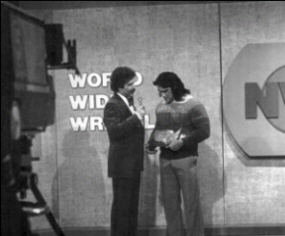
Longtime fans of Jim Crockett Promotions television will remember the popular syndicated program Wide World Wrestling (later known as World Wide Wrestling). The major hosts of that program over the years were Ed Capral, Rich Landrum, David Crockett, and Tony Schiavone. But even the most hardcore JCP fans may have forgotten a fellow who hosted that show in the late 1970s due to his relatively short tenure - - Russ Dubuc.


In the late fall of 1977, Jim Crockett Promotions parted company with host Ed Capral, the longtime Atlanta TV wrestling host who came to JCP after being pushed out of Georgia politically on the wrong side of the NWA/Gunkel wrestling wars of the mid-1970s. He became the inaugural host of  Wide World Wrestling when JCP launched the new show in 1975.  JCP replaced Capral with a local Charlotte radio and TV personality by the name of Russ Dubuc. 

HOME  |  MID-ATLANTIC BOOK STORE  |  STUDIO DIRECTORY
ABOUT  |  CONTACT  |  MID-ATLANTIC GATEWAY  |  DOMED GLOBE

I've long thought of Russ Dubuc as the "lost voice" of Wide World Wrestling. He was only on the job with JCP for about five months. Since none of those episodes exist anymore, and it only aired in about 60% of the Crockett TV markets at that time, Dubuc is largely forgotten in the annals of Crockett Promotions television history. And it was, after all, over 46 years ago. 

Dubuc had been both a radio and TV presence in the Charlotte area for roughly a decade, most notably as an AMS-certified meteorologist for WSOC channel 9 television, where he appeared on both the 6 PM and 11 PM newscasts. At that time he was the only AMS certified meteorologist in the Charlotte demographic market.

1970 ad for WSOC's Eyewitness News featuring Russ Dubuc


Russ remembers it was Jim Crockett, Jr. who called him and offered him the job. Crockett was familiar with Dubuc's work at channel 9. 

In a telephone interview, Russ told me about some of his memories of his short time in the wrestling business. On Wednesday afternoons, the day of the week wrestling was taped at WRAL television studios in Raleigh, he would meet with others at a parking lot on highway 150 in Concord and carpool up to Raleigh for the day. He would typically travel with someone from the office, and that also occasionally included wrestlers. 

The wrestlers he remembered working with the most on TV included Ric Flair, Wahoo McDaniel, Blackjack Mulligan, Ricky Steamboat, and a few others. He loved the work, and had been a huge fan of wrestling himself before getting the gig, but did express frustration over how he was thrown right into the fire hosting the show without much preparation. He wasn't "smartened up" at all, and was told to simply call it as he saw it. He felt that limited his performance for them somewhat. 

But his most vivid memory of his time in wrestling wasn't in the television studio behind the mic. It had to do with traveling back and forth to Raleigh. His exact words: "Wahoo McDaniel was a maniac!" He laughed as he told about how Wahoo drove like a wildman and would often blow past the car Russ was traveling in at very high rates of speed.

AUDIO RECORDING
I recently came across an audio recording of an episode of Wide World Wrestling hosted by Dubuc from February 4, 1978. I was delighted to have the opportunity to document his contributions to Jim Crockett Promotions with a sample of his voice from that program.

In this clip, Dubuc is making fans aware of how they can get their very own free Wide World Wrestling bumper sticker. At the end of the audio clip you'll briefly hear the voice of Ricky Steamboat, his guest color-commentator for the week. The audio was recorded on a handheld cassette recorder and is pretty low fidelity, especially given the condition of the cassette when it was unearthed. But you should be able to make it out:


In the early spring of 1978, Dubuc was replaced as host of Wide World Wrestling by Tom Miller. Booker George Scott, Crockett's booker at the time, co-hosted the program. Russ thought they probably weren't happy with him. But the only explanation he was given at the time was that he was taller than most of the wrestlers and that wasn't a good look on TV. Oddly, "Truckin'" Tom Miller was nearly as tall.

No photos seem to exist of Dubuc on the job at the wrestling tapings at WRAL, but we were able to locate some video of him calling a water-skiing tournament for ESPN in the early 1980s, and captured this still image of him alongside ESPN personality Kevin Slaten.

Russ worked in many fields over the years. In addition to his work as a weathercaster for WSOC in Charlotte and his short stint as host of Wide World Wrestling, he also ran a water-skiing school in Davidson, NC and was a snow skiing instructor and worked ski patrol in Brekenridge and Vail, Colorado. He was the lead actor in a 1977 film shot in Charlotte called "Another Son of Sam." He was a top sales person for BG Distributors in Raleigh, NC, and later owner of the BG distributorship in Wichita, Kansas.  He now owns and operates his own travel business, RD Travel Limited, Inc., a Kansas City travel agency. 

Teacher, trainer, broadcaster, actor, salesman, business owner, travel advisor - - - add to that waiting tables, dirt track racing announcer, radio DJ, and wrestling announcer, and you have a very well-traveled and well-rounded individual. A very nice fellow, too. I enjoyed our telephone conversation. As fans, we are proud to call him a Jim Crockett Promotions alumnus.

- Dick Bourne
Mid-Atlantic Gateway
Thanks also to Carroll Hall
Updated April 2024
from an original post in April 2018

Wide World Wrestling Theme Music 1975-1978


Check out this post on the Mid-Atlantic Gateway with streaming audio of the "Wide World Wrestling" theme music used during the time Russ Dubuc was host of the program.

HOME  |  MID-ATLANTIC BOOK STORE  |  STUDIO DIRECTORY
ABOUT  |  CONTACT  |  MID-ATLANTIC GATEWAY  |  DOMED GLOBE

Tuesday, April 16, 2024

Bruce Mitchell: One Night at the WRAL Wrestling Tapings (1980)

By Bruce Mitchell
Special for Studio Wrestling and the Mid-Atlantic Gateway
Originally published in 2008
 

The line stretched all the way down the sidewalk.

We were in front of the WRAL TV studios in Raleigh, North Carolina early one Wednesday evening in 1980, waiting to get into a Mid Atlantic Championship Wrestling show taping. I was the devout fan who would leave the UNC-Greensboro Strong dorm keg parties at 11:30 sharp every Saturday night, bend the rabbit ears around, and settle in to watch a slightly snowy MACW show out of Raleigh on my portable black and white TV. The rest of the group was pretty eclectic – Johnny, one of my old high school friends, his brother Henry, a student at Duke Divinity School, their mother Rose (I still don't know how that happened) and some of the brother's buddies. This group was there for the spectacle, (Henry had worked part-time at Dorton Arena and seen some shows from the back) and included some skeptics. I was the only one who knew who all the wrestlers were and who was feuding with whom.

Henry, the Duke Divinity School student, came in handy, at least his sense of ethics did, because he created a phony church name for us to use when requesting free tickets from WRAL. They gave us more tickets that way.

Not surprisingly, Henry subsequently left the ministry to become a successful lawyer.

As we waited in line it was pretty clear some of the folks waiting with us were regulars who came to the tapings every week. I was a closet wrestling fan at this point who didn't know many other fans, so it was pretty cool to be able to eavesdrop on people in line as they speculated on what was coming next in the promotion. It would take me some years before I would become a member of a community of fans like that.

The wait was broken up a little when Rich Brenner, then the sports anchor at WRAL, came out and greeted some fans on the way to his car. Brenner was drawing huge ratings in the area at the time, and was soon lured to a big market job in Chicago. I mention this because the weekend anchor, Tom Suiter, took his place and remains at WRAL to this day. Suiter is the best local sports anchor I've ever seen, and Brenner isn't far behind. Brenner soon returned to North Carolina and recently retired from WGHP in Greensboro, another station where Mid Atlantic Championship Wrestling was taped for years, so I've been watching both guys off and on for three decades. In those days of three television station choices, local news was more intertwined in the lives of the community, so you can see how these two sports guys, their station, and Mid Atlantic Championship Wrestling are, to me, all part of the same tapestry.


WRAL today. (Photos by Dick Bourne at the Mid-Atlantic Gateway)

After a wait almost as long as it took me to connect Tom Suiter to pro wrestling, we were let into the TV studio where the wrestling action was filmed. The first thing that stood out, obviously, was the wrestling ring. Since we were all sitting on one set of bleachers every seat in the house was close. I figured it was about as close to the front row at one of these shows as I was ever going to get.

Not only were the fans close to the ring, we were close to each other. The real job of security that night was to encourage us, as we settled into the bleachers, to "move over", "scootch down", "scrunch up", and "C'mon, let's get one more, folks," as they tried to fit everyone in before the taping started.
I, for one, was prepared for my big chance to be on TV. I worked part-time at the late, lamented South Square Mall Belk's Department Store in the Men's Budget department, so I was sporting a green three-piece polyester suit that was sure to stand out even on a black and white TV screen. The poor lady crammed up against me on that bleacher for two plus hours probably didn't notice how much I sweated that night.

It wouldn't be the first time I had been on a TV show that had been taped at that studio, either. When I was a kid my parents brought me to a taping there of The Uncle Paul Show ("And now it's time for Uncle Paul and all his friends…"). Many major TV stations had their own local kiddie show host, and Uncle Paul was WRAL's version. I dutifully marched in the Happy Birthday March that day, but my favorite part of the show was when the fleas in Uncle Paul's hat would sing their little high-pitched songs.

Interestingly enough, Uncle Paul (Paul Montgomery) was legally blind, and if you looked closely you could see him at the podium reading his Braille show notes with his fingers.

One of the coolest things about this night came before the taping. Wrestling news could be hard to come by in those days, so David Crockett, the MACW color man, walked over to casually chat with fans in the bleachers. He let us know that the Iron Sheik had recently beaten the fresh-faced favorite Jumpin' Jim Brunzell for the Mid Atlantic title, the second biggest title in the territory. Most fans were distressed at the news.

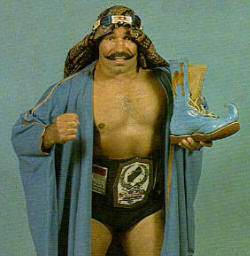
Not me. I got a huge kick out of the Iron Sheik, his unique interview style, his Iranian Club Challenge and his  pointy toed boots, so I was glad he beat that goody-two shoes Brunzell. (I also noticed how the Iranian Sheik or anyone else in the promotion never mentioned the American hostages the Iranian government held at the time. I'm pretty sure the fans got the point anyway.)

Crockett let us know that Brunzell would get his re-match tonight for the title, so we had picked a good night to be there. (Many, if not most, MACW television shows of the time didn't feature main event matches, preferring to whet the appetite of fans for those matches, not quench it.)

As the show started, I looked for another high school friend, Aaron Thompson, who worked as a cameraman at the station. I wanted to see the look on his face when he saw us there, and sure enough, he recognized me and mouthed, "What the hell are you doing here?"

I just laughed.

They were taping two shows (as they usually did) that night – the syndicated hours of Worldwide Wrestling and Mid Atlantic Wrestling. Worldwide Wrestling was taped to begin the night, so that meant host Rich Landrum and the Dean of Wrestling Johnny Weaver were out first.

Rich Landrum had a real sense of style. Some of the leisure suits he wore on the show could hold their own even against David Crockett's assortment of multi-colored sport coats, and he had one of the great perms of the era.

Landrum was also a smooth, enjoyable play-by-play man who had a real respect for the wrestlers and what they did. He had a pleasant chemistry with Johnny Weaver, and it wasn't surprising to hear that they resumed their friendship in recent years. Weaver used to tell Landrum whenever some wrestler was trapped in, the corner of, say, The Masked Superstars I & II, with no hope of making a tag, that the poor guy was caught in "Rich Landrum's No Man's Land."

What, you thought "Stone Cold! Stone Cold! Stone Cold!" was the first announcer catch phrase?

Weaver's trademark on Worldwide Wrestling, of course, was singing Willie Nelson's "Turn Out The Lights, The Party's Over" as some hapless wrestler was clearly beaten once a show, just like Don Meredith did back then on Monday Night Football when the game was clearly over. I say, of course, but former WCW announcer Chris Cruise didn't believe me when I insisted he include that in his introduction of Johnny Weaver for his induction into the NWA Legends Hall of Heroes.

Cruise, who grew up in Maine watching Chief Jay Strongbow, thought I was ribbing him (even after a lot of yelling), so he asked the audience at the Hall of Heroes ceremony, "What was it that Johnny sang?" and was surprised when the fans sang one last time for the Dean.

Mid Atlantic Championship Wrestling had a great talent roster back then. Ric Flair was the top star, the heroic U.S. champion and number one contender to Harley Race's NWA Heavyweight championship (at least in the Mid Atlantic and sometimes St. Louis territories), and watching him up close laser-in on the camera with that supreme confidence was something to see. I was disappointed that Blackjack Mulligan wasn't there that night, as I would have loved to hear him go on about Reba Joe and just how they settled things out back at two in the morning. Greg Valentine was strong and mean, and even then I knew he was an exceptional wrestler. I was also a big fan of Ray "The Crippler" Stevens talking out of the side of his mouth. You knew he could whip any and everybody's asses in the bar, no problem.

Jimmy Snuka was, to that point in my life, the single biggest and scariest bastard I'd ever seen. I had just watched Flair beat him for the U.S. title in the Greensboro Coliseum. Five years later, though, that same size would put Snuka in the middle of the pack for pro wrestlers.

Number 1 Paul Jones had just turned back good after an entertaining NWA World Tag Team Championship run with Baron von Raschke and a brief stint in Florida Championship Wrestling as Mr. Florida. I enjoyed the stories in the wrestling magazines about the mystery behind Mr. Florida's identity, when one look at Mr. Florida's picture solved the riddle for me. (I didn't enjoy the looks on the convenience store clerk's faces when I bought the magazines, with their blood-soaked cover shots, to the counter.)

Ricky Steamboat & Jay Youngblood were there, and they are still the single best, most effective tag team I've ever seen. Their synchronized style paved the way for all the great tag teams that followed that decade, and man, did their devoted fans love them. They would erupt in ecstasy and relief when, say, Youngblood finally, finally, escaped the double-teaming of Jones & Von Raschke and tagged in Steamboat for some much deserved retribution.

It was cool to see the guys cut their promos for the syndicated shows, how they calmly waited for the cue and then either revved themselves up for revenge, or matter of factly explained why it only looked they were cheating.

I was disappointed I didn't get to see the wrestlers do my favorite part of the show – the localized promos that came at the second and last breaks on the hour. (I didn't know that taping those promos took hours every week, what with all the markets the company had to cover.) First the bad guys would hype the matches and explain the stipulations for the next local show, then the good guys would get the last word, since (hopefully) they spoke for the fans.

The fun part was how the wrestlers would drop in local color, including the clubs they might party in after the matches, and try to out-do and entertain the other wrestlers who were waiting their turn to talk. Like any sport, pro wrestling had its own code. For example, if, on a local promo, Ric Flair said the magic words, "bleed, sweat, and pay the price of a wrestling lifetime," someone was going to catch a beating at the local arena.

On the other hand, if Paul Jones said, "Let me tell you something right now", that meant Paul Jones was going to tell you something right then.

Even the localized promos had a WRAL flavor, wherever you were watching them, because the man who intoned the deathless words "Let's take time for this commercial message about the Mid Atlantic wrestling events coming up in your area" (code for "Head's up – here comes the good stuff") was the station's then Biggest Name in Weather, Bob Debardelaben.

The matches on Worldwide Wrestling were pretty straightforward that night. The main event wrestlers took on the likes of Nick DeCarlo, Young Lion Vinny Valentino, Don Kernodle (who would main event his hometown of Burlington, North Carolina years before he main evented the entire territory) and veterans like Abe "Kiwi Roll" Jacobs and Swede Hanson, who at that point may have sported the greatest perm in the sport's history, better than Landrum's or Canadian Champion Dewey Robertson's.

My favorites on this side of the roster were Tony Russo and Ric Ferrara, who looked like beer kegs with short, stumpy legs. They teamed together this night, I couldn't tell you against who, and the crowd enjoyed their work, well, actually they enjoyed the slightly risqué sight of their boxer shorts peeking over the tops of the trunks, the first hint of what Russo and Ferrera would bring to the business in the years to come.

One of the coolest moments of the night for me came just after the Worldwide Wrestling taping ended. Rich Landrum caught the attention of referee Sonny "Roughhouse" Fargo, who was still in the ring, and pantomimed with a nod and a wrist twist asking Fargo whether he wanted to have some refreshment later. Why they didn't invite me to go with them I'll never understand. Maybe it was the green polyester suit.

The Mid Atlantic Championship Wrestling show was taped next, and the long-time voice of MACW, Bob Caudle, came out. Caudle was a former weatherman at WRAL. He worked during the day for the Constituent Services department of North Carolina Senator Jesse Helms, the former news director and editorialist at WRAL.

(No wrestler or politician ever cut more effective promos than the ones Helms delivered during his famous "Viewpoint" editorials on the station – " I don't know why taxpayers would be asked to build a zoo in Asheboro when you could just put a fence around Chapel Hill.")

David Crockett joined Caudle. Crockett told wrestling fans directly who to root for and why, so enthusiastically that many fans secretly enjoyed it when bully Greg Valentine knocked him on his butt for sticking his nose in his and Ray Steven's business one too many times.

It was time for the promised main event – Jim Brunzell's chance to regain the coveted Mid Atlantic title from the Iron Sheik. Up to then, the fans in the studio had enjoyed the matches, but they had a strong idea who was going to win each match, and the skeptics, at least in my little group, remained unconvinced.

Jim Brunzell was the well-mannered All American boy who any dad would be proud to have take his daughter to the church social, and stood in stark contrast to the foreign born Iron Sheik. He may have had the biggest teeth in wrestling.

Now, though, it was time for Jumping Jim to get his chance for revenge. You see, Brunzell had had the Iron Sheik all but beaten in their last championship match, when the referee unfortunately went down, young idealistic Brunzell went to help him up, and The Sheik took his opportunity to tap his right boot toe-first three times on the mat.

Why did The Iron Sheik do such a strange thing at such a critical time in this championship match? His manager, Gene Anderson of the famed "A table with three legs cannot stand" Anderson Brothers championship tag team, explained that the Sheik had problems with circulation in his legs, and was just banging on the mat to get the feeling back in his foot.

Brunzell claimed that The Iron Sheik did that to load the curved end of his boot with lead.

Whatever the reason, The Iron Sheik did what he did, then kicked Brunzell in the ribs, Brunzell went down like a shot, the revived referee counted three, and the entire Mid-Atlantic area was ruled by a champion from Iran, the country that refused to return our American hostages.

So, as you can see, there was a lot at stake in this re-match. What made it even better was that both Jim Brunzell and The Iron Sheik were, at the time, damn good wrestlers and a top level performance in a match like this across the MACW syndicated TV network might lead to big money main events for both.

Brunzell had a tremendous standing dropkick and The Iron Sheik at that point in his career had an array of suplexes second to no one in the sport. (Sadly, a few years later, during his famous WWF run, he had lost much of both his in-ring energy and suplex array.) The two tore the studio down (if only symbolically, since the action stayed in the ring) from the very beginning of the match.

That action picked up even further, though, when it became clear Brunzell had lost his manners and was up to something more than just beating The Iron Sheik for the title - something that the Sheik and his manager Anderson were desperate to stop.

Pandemonium.

Brunzell was trying to rip the Iron Sheik's allegedly loaded boot right off his leg, and the fans in the studio, who clearly thought he was justified in this action, were going crazy.

Brunzell got the boot, too, but, alas, he was disqualified and lost this chance to regain the Mid Atlantic title for the people of the area. What Brunzell did get, thanks to a ruling from the athletic commission, the National Wrestling Alliance, the promotion, somebody important, that fair was fair, and he deserved the right to wear that boot, the same boot The Iron Sheik kicked him with to win the Mid Atlantic title, in any subsequent rematches for the belt.

Anderson and the Sheik protested, but to get what was now Brunzell's boot banned they had to admit the boot was loaded in the first place, and risk both having the title win rescinded and getting suspended from the territory. This was the best wrestling territory in the country, so they couldn't have that.

So, you see, Brunzell was a shoo-in to get his revenge and regain the Mid Atlantic championship from the hated Iranian. After all, he had the Sheik's loaded boot, and the right to use it.

I mean, you had to buy a ticket for that match when it came to your local area, right? A Brunzell title win was virtually guaranteed!

I knew I was in the hands of master craftsmen when, after that match, one of the skeptics turned to another and said, "I don't know about the rest, but that last match was real!"


More from Bruce Mitchell on the Mid-Atlantic Gateway:
A Thanksgiving Surprise: Starrcade Magic Returns to Greensboro
The Lightning and Thunder of the Nature Boys
 
For more information on the history of wrestling at WRAL television studios from the 1950s to the 1980s, visit the WRAL page at the Studio Wrestling website (part of the Mid-Atlantic Gateway family of websites.) 

This article was first published on the Mid-Atlantic Gateway in support of the Studio Wrestling history section of the Gateway in 2008, and again in 2011 for the Studio Wrestling website.

Thursday, August 24, 2023

Rich Landrum Passes Away

Sad to report that Rich Landrum passed away quietly back on August 14. Rich is fondly remembered as the host of Jim Crockett Promotions' World Wide Wrestling syndicated wrestling show from October 1978 until early 1982. He was 77 years old.

Long time Richmond, Virginia fans will also remember Rich as the ring announcer in Richmond throughout the 1970s and early 1980s, introducing matches at the Richmond Fairgrounds at Strawberry Hill, the old Richmond Arena, and at the Richmond Coliseum.

His broadcasting career began in local radio and television in Richmond. He got his break in wrestling when attending matches at Strawberry Hill in 1971 with family and friends and the regular ring announcer didn't show up.  Promoter Joe Murnick asked him to fill in that night. Murnick liked him and began using him as his regular announcer from that point forward.

Rich Landrum interviews Ricky Steamboat on the set of World Wide Wrestling, circa 1978.


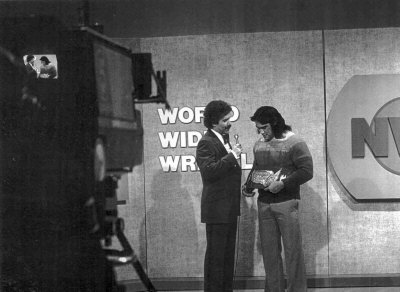
He replaced "Truckin'" Tom Miller as host of Wide World Wrestling in October of 1978. Jim Crockett had WRAL build a new set for the show and renamed the program World Wide Wrestling and Landrum debuted as its new host. 

After moving TV production from WRAL in Raleigh to WPCQ in Charlotte in the late summer of 1981, JCP balked at the ongoing expense of flying Landrum in from his home base in Richmond VA every week and asked him to begin driving it. Rich was unhappy with that arrangement which led to his eventual departure from the company in the early months of 1982. David Crockett assumed host duties of the show at that point, eventually joined by Tony Schiavone in 1984.  

Johnny Weaver and Rich Landrum


Landrum will likely be remembered best by fans for his on screen partnership with co-host (and legendary pro wrestler in that area in the 1960s and 1970s) Johnny Weaver. Landrum dubbed Weaver "the dean of professional wrestling" and the moniker stuck, and the two had great chemistry hosting the show together for several  years. 

Obituary on DignityMemorial.com

OTHER LINKS
More from the Studio Wrestling Website
WRAL Studio Page
WPCQ Studio Page
Rich Landrum related posts on the Studio Wrestling website

Tuesday, August 1, 2023

Studio Wrestling Interview: Video Tech Tom Gallagher from WRAL

Tom Gallagher worked in videotape at WRAL television from 1979 until 1982 and his adventures with the JCP wrestling crew that moved into the Raleigh studio "A" every Wednesday paint the most complete picture of a day at WRAL wrestling tapings that has yet been published to our knowledge.

Tom and I were introduced via e-mail and I asked Tom to share with us his role in the wrestling tapings. Presented below is Tom's recent letter to me regarding those memorable Wednesdays. 
 
- Dick Bourne, January 2009

********************************************

An Email From Tom Gallagher

Most of what I would contribute regards the technical nature of the show, from 1979 to 1982 when I worked videotape at WRAL-TV.

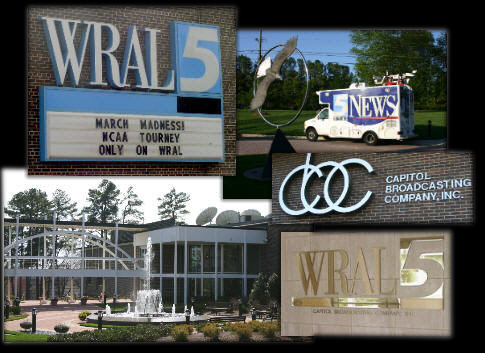
To orient you, the videotape room at WRAL was in the basement, near the corner below the “WRAL-5” message sign that can be seen behind Bob Caudle in a picture on the Gateway. The studio was on the ground floor, and the production control room was on the second floor almost directly over the VTR room.

Just about every Wednesday, wrestling would take over production at WRAL-TV after the noon news and, except for the six o’clock news, was about the only thing that would happen for the rest of the day. It’s pretty well documented elsewhere that the shows (World Wide Wrestling and Mid-Atlantic Championship Wrestling) were taped in the evening, so I’ll deal with the afternoon session.

On Wednesday afternoons we produced the 2:20 commercials that followed the announcement “Let’s take time out for these commercial messages about the [World Wide / Mid-Atlantic] wrestling events coming up in your area.” This was the whole basis of the economics of these shows: stations got an hour of programming material that they didn’t have to pay money for, and the promoters got almost five minutes of commercial time to plug their local arena matches. ("Mid-Atlantic Championship Wrestling has been furnished to this station for broadcast at this time by Jim Crockett Promotions, in exchange for commercial consideration.") These spots ran at about twenty and forty minutes into the show. To sweeten the deal, there were commercial positions within the show that the station could sell to even make a profit, or maybe just pay the electric bill to keep the transmitter running.


The WRAL Video Tape Room


The studio was set up with just the background flats; the ring was kept on the truck and set up during the six-o’clock news break. As you can see from the pictures, we had exactly four high-quality (“quadruplex”, or “quad”) recorders that used 2” tape. Only two of them had the modules that allowed electronic editing, the alternative being a razor blade and adhesive tape. Almost all the stations that aired wrestling did it from 2” tape (the exception was Bluefield, which used BVU ¾” tape). I don’t believe any station got the show on 1” BVH. Those were the days when VTRs weighed half a ton and cost a quarter-million apiece. WRAL was lucky to have four (FOUR!) 2” VTRs. Since only four copies of each show existed, and they had to be air-shipped on Thursday to get to the stations on Friday before the program managers went away for the weekend, there was no time to make copies of shows.

What happened to the tape reels was described as a bicycle wheel, or “the bicycle.” No, we didn’t send the shows out on the back of a bicycle! If you imagine Raleigh as the hub, and the various cities on the rim, the show tapes travelled up and down the spokes. I don’t recall the specific order, of course, but the show that aired in High Point, for example, would come back, have new commercials edited in, and get sent back out to Louisville, come back, get new commercials edited in again, and then be sent back out to Buffalo. After the first week, each show would air in only four markets (Bluefield would always get the new show on ¾”, which would make five the first week.) Each show might be airing each week, somewhere, for as long as a month or more.

Producing and editing the commercials is what happened Wednesday afternoon. We edited live-to-tape, which means that as the talent was promoting the match for a city we were recording on the tape that would go to that city. On the production side, the floor crew usually had the likes of David Gill, Leonard Peebles, Rick Armstrong, Art Howard, Tilla Fern, Kara Carite, and others. The control room had Ruth Miller or Joe Johnson on audio and, depending on the week, directors George Pemberton, Bob Gubar, Kevin Duffus, Bud Brown, Tom Lawrence, Pam Parrish (Pam Paris?), or Connie Goodman. I was all alone in VTR.

My job started during the noon news. Carl Murnick would bring down about two-dozen tapes. I would cue each tape to the beginning of the first 2:20 (two-minute twenty-second) commercial, then dismount both the supply reel and the take-up reel from the tape machine. In the wide shot of the tape room (above) you can see the last eight tapes for the day stacked on the floor. To make an edit, I would load a tape onto the machine, find the exact beginning of the commercial to be replaced by the edit, zero the tape time counter, and then rewind the tape about thirty seconds. From thirty seconds back, I would play the tape and make several mechanical and electronic adjustments to the machine, while watching the timer and counting-down to the beginning of the commercial so that the studio could cue the talent (Mr. Landrum or Mr. Caudle). There was a 2/3-second delay between when I pressed the “edit” button and the actual edit, so I had to account for that. As soon as the recording started, I would move to the second machine and load that tape, cue it up, and get ready for that edit--- hopefully before the first 2:20 commercial was done, because I had to have my finger on the button to end the edit recording, otherwise we would be recording over the show! After ending that first edit on the first tape, I would put that tape into fast-forward to get to the second commercial, move to the second machine and make the first edit there, move back and cue-up the first machine to the second spot while the second was recording, end the second machine and edit the first, cue up the second, end the first and rewind and take off and cue up a new tape, and so on and on.


Tom Gallegher on the job in the WRAL video tape room.


If it sounds complicated, it sure was. It was OK once you got used to it.

I would record the commercials to be edited into the shows recorded that night onto the 1” tape machine, and Carter Bing or Walter Armstrong would edit those commercials into the tapes before they were shipped.

About halfway through the afternoon, we took a break from production while the studio flipped the background flats around from the “A” show to the “B” show; yep, as folks who went to the studio tapings will attest, the only difference between the shows was which side of the background flats faced the camera! One side had “Mid-Atlantic Championship Wresting” on it, and the other side was “World-Wide Wrestling.”

As soon as we finished taping the commercials, everyone split for dinner or some other sort of refreshment.

As I mentioned above, the late Carl Murnick handled all the tape routing and shipping. Now, I can’t say anything about Elliot or Sonny Murnick or any of the Crocketts--- they hardly ever made it down to videotape--- but I’d give anything to work with the likes of Carl again. He always treated me well, and on the numerous occasions when I made mistakes he always took it good-naturedly, shrugged it off, and simply trusted me to do better in the future. Every week, he brought down a box of chicken and a corn-cob from the Church’s chicken down the street, and that was my dinner every Wednesday. I appreciated that more than he ever could imagine, because I wasn’t making very much working in TV and it would often be the best meal I had all week. When C&M eventually got their own remote truck I was urged to go after the tape job, but I had gone back to school and wasn’t where I could change jobs, but I was sorely tempted based on the good treatment I got from Carl.

Also, as I mentioned above, the tape job was a bit complicated and, when I first started, I was a bit slow. So slow, in fact, that we’d finish the afternoon session after five-thirty, a bad thing since they had to move the cameras back over to another studio to do the six-o’clock news. (WRAL had three studio cameras. At $65,000 a pop, most stations only had two. Field cameras for ENG and EFP were about the same price.) A late finish was not desired by either the client or the crew, to put it mildly. After a couple of weeks of late wrap-ups on the promos, the wrestlers decided that enough was enough and deputized Gene Anderson to take care of the problem, which was me.

Gene came down to the tape room, which you can tell from the pictures had a pretty low ceiling, and proceeded to impress on me how desirable it was for me to do a bit better in my job. I don’t remember what he said, but I can tell you that it was the most inspirational, motivational, sensational talking to I have ever heard. I was scared witless. I just knew the cane he carried was going to impact me somewhere (it never did.)
 
Over the next week, I carefully laid out plans, practiced my editing, reviewed my plans again, practiced editing some more, and did a whole lot of praying that it would be enough.
 
By the following Wednesday, I was one of the best VTR guys on the East Coast.

As weeks went by, I got even better, which led to some eventual mischief. You probably noticed that the 2:20 promos started out the same way --- Rich Landrum giving the where and when for the local arena shows--- and the wrestlers would amble into the shot for a few moments to shout threats of violence at their opponent in that town (who was likely sitting on the bleachers a few feet away munching on some chicken.) All the while, Rich stood there holding the microphone. As a matter of fact, Rich had to stand there through all those 2:20 promos, and the only break he would get was between promos, while the studio and control room waited for the guy in VTR (me) to set up for the next edit. Well, I got things so fine-tuned that I all but eliminated the pause between promos; Rich would be lucky to have ten or fifteen seconds to rest his arm, and forget about stepping out from under the lights (still quite warm, back then!) We got the rhythm going, and before you knew it Rich had been out there continuously for about forty-five minutes without much of a break at all. Finally, HE had to ask the entire production to stop so he could take a break. I can’t remember what I said, but I’m sure it was some wise-butt remark.

Anyway, sorry Mr. Landrum. You just have to know, some of those other guys were bigger than you, and they wanted me to do things as fast as could be done!

- Tom Gallagher, January 22, 2009


The credits roll at the end of another edition of Mid-Atlantic Championship Wrestling.


Copyright © 2009 Mid-Atlantic Gateway • Photos courtesy of Lee Collins. Photo (from newspaper clipping) of Carl Murnick courtesy of David Bullock.

Originally published on the Mid-Atlantic Gateway in January 2009