Showing posts with label 1950s. Show all posts

Sunday, February 22, 2026

History of Georgia Wrestling on Television

The following is a post by Georgia Wrestling historian Rich Tate from 2003 on the old Wrestling Classics message board. It is included here for historical purposes. [LINK]

More specific information about the period following Black Saturday in July of 1984 can be found on the Mid-Atlantic Gateway in the article Ole and Solie: The Evolution of TV Wrestling in Georgia after Black Saturday

* * * * * * * 


RICH TATE: I am attempting to piece together a timeline for wrestling on TV in the Atlanta area. Can anyone make corrections or fill in gaps? Especially after Black Saturday...that's where my most confusion lies. Also, if anyone can add to it by adding in what may have been happening in Macon, Columbus, Augusta and Savannah, it's very much appreciated. (Bold and italicized text is mine.)

1954: Live Atlanta Wrestling first appeared on WLWA Channel 11 (ABC affiliate), a three-year-old station, hosted by Ray McCay, who had previously been doing the radio broadcasts of local shows on WQXI-AM 790. The show would jump around the schedule throughout its run on this station, and seemed to become an afterthought more and more as time went on. Prior to that, local fans could only see what the network feeds brought in, and more recently, the shows had been sent in via tape from Texas.

1955: Ed Capral, who had been the ring announcer, replaces McCay on Live Atlanta Wrestling.

1961: Channel 11 ownership changed hands, and its call letters became WAII.

1969: Once again, new owners took over at Channel 11, and the call letters became WQXI.

1970: On January 1, Atlanta independent UHF Channel 17 (WJRJ) is purchased by Ted Turner and renamed WTCG. Les Thatcher began working as a co-host and associate producer, a position he would hold for three years.

1971: Live Atlanta Wrestling changed its name to Georgia Championship Wrestling, beginning with the program shot on August 14. On December 25, Georgia Championship Wrestling aired for the first time on WTCG in a permanent time slot, with taping in the afternoon, and airing each Saturday at 6:00 pm. This was the reason the promotion decided to change stations. It had become very difficult to keep fans coming to the studios for live matches when the schedule was so varied at Channel 11.

1972: In June, WTCG begins re-airing its Saturday tape on Wednesday night as a prime time replay. This lasted until the fall. On December 2, WTCG began airing back to back episodes of Georgia Championship Wrestling and All-South Championship Wrestling in back to back Saturday evening slots. Capral changed over immediately to the All-South program, and Sterling Brewer was called in to cover the announcing for GCW, while maintaining his job in Birmingham for Nick Gulas’ show.

1973: Brewer was replaced on Georgia Championship Wrestling by Gordon Solie, who continued to do the announcing for Championship Wrestling from Florida out of Tampa. During the summer, Georgia Championship Wrestling shifted to morning hours to tape their programs.

1974: After the closing of All-South, Georgia Championship Wrestling continued on as the sole wrestling show on WTCG.

1976: A second program, called Best of Georgia Championship Wrestling, began airing on WTCG hosted by Freddy Miller. On December 17, WTCG became the second satellite-delivered cable program service (behind Home Box Office), and the first satellite superstation. The first Georgia Championship Wrestling show that could be seen beyond Atlanta was taped and aired on December 18.

1979: WTCG changed its call letters to WTBS on August 27, with the first Georgia Championship Wrestling show taped and aired on September 1.

1982: Georgia Championship Wrestling changed its on-air name to World Championship Wrestling.

1983: A co-promotion initiated between Ole Anderson and Jerry Jarrett called GCW Superstars aired for three months on WTBS, produced and hosted by Les Thatcher.

1984: On July 7, the final episode of World Championship Wrestling taped and aired on WTBS, and fans were introduced to WWF programming the following week. The WWF debuted on July 14 in WCW’s former time slot, on a day that has been dubbed by fans as “Black Saturday.” In September, a new promotion operated by Ole Anderson and Ralph Freed got an early morning time slot on WTBS each Saturday. The promotion and the show were both called Championship Wrestling from Georgia, and Gordon Solie was back as the announcer. Meanwhile, Turner sold a Sunday night time slot on WTBS to Mid-South Wrestling, hosted by Jim Ross.

Gateway Note: More specific information about the period following Black Saturday in July of 1984 can be found on the Mid-Atlantic Gateway in the article Ole and Solie: The Evolution of TV Wrestling in Georgia after Black Saturday

1985: Jim Crockett bought the Championship Wrestling from Georgia business and time slot on WTBS, and began airing World Championship Wrestling on the time slot he purchased from Vince McMahon. This version of the program was hosted by David Crockett and Tony Schiavone

Joe Pedicino began producing and hosting a show on WATL Channel 36 (Independent) that aired each Saturday night, starting at 8:00 pm. It lasted through 2:00 am, and showed tapes from various promotions around the world in their entirety.


Some responses are included below with additional or clarrifying information.

[A] KING COMBO: 
1983: A co-promotion initiated between Ole Anderson and Jerry Jarrett called GCW Superstars aired for three months on WTBS, produced and hosted by Les Thatcher."

AFAIK, didn't the full shows only air in Chattanooga (where the show was taped), and only selected matches aired on the Sunday show w/ other GCW footage?

"1984: On July 7, the final episode of World Championship Wrestling taped and aired on WTBS, and fans were introduced to WWF programming the following week. The WWF debuted on July 14 in WCW’s former time slot, on a day that has been dubbed by fans as “Black Saturday.” In September, a new promotion operated by Ole Anderson and Ralph Freed got an early morning time slot on WTBS each Saturday. The promotion and the show were both called Championship Wrestling from Georgia, and Gordon Solie was back as the announcer. Meanwhile, Turner sold a Sunday night time slot on WTBS to Mid-South Wrestling, hosted by Jim Ross."

The show was still called World Championship Wrestling (in the intro and on the studio banner) after Black Saturday. The "coming up next..." slates on TBS still referred to the show as Georgia Championship Wrestling, as did Gorilla Monsoon. The show had original interviews at this point but no original matches.

It is worth noting that of the 3 shows, Mid-South drew the highest ratings (making it the highest rated show on cable at the time).

"1985: Jim Crockett bought the Championship Wrestling from Georgia business and time slot on WTBS, and began airing World Championship Wrestling on the time slot he purchased from McMahon. This version of the program was hosted by David Crockett and Tony Schiavone. 

Joe Pedicino began producing and hosting a show on WATL Channel 36 (Independent) that aired each Saturday night, starting at 8:00 pm. It lasted through 2:00 am, and showed tapes from various promotions around the world in their entirety."

Somewhere in February-March, the WWF buckled to Turner's pressure and moved the W/GCW show to the studio on Techwood Drive for its own tapings w/ Gorilla Monsoon as host and Freddie Miller as ring announcer. This lasted about a month or so before the slot was sold to Crockett. These tapings featured the studio returns of Mr. Wrestling II & Roddy Piper.

"1986: Ann Gunkel starts a second version of All-South Championship Wrestling that aired for several weeks on WANX Channel 46 (Independent), hosted by Les Thatcher."

I believe this was the year of the first showing of the "History of Atlanta Wrestling" special on WATL, along w/ the first Wrestlethon (24 hours of various footage hosted by Pedicino w/ phones manned by wrestling personalities taking donations for local charities). Wrestlethon '88 featured the return of live studio wrestling in Atlanta, w/ several matches done at WATL, and a feature on the Fox Network's late show.

Someone else probably knows more about North Georgia, SCW, NWA Georgia/Wildside, etc.

[B] RED MASK: Rich, Championship Wrestling From Florida w/Gordon Solie aired on WTCG Channel 17 Saturdays at 7pm right after GCW at 6pm around late '74/'75 after All-South went down.

[C] CINCINNATI KID: wish I could give you more information on the wrestling on TV in Atlanta. I do note that the station that initiated the shows was WLW-A, which was owned by the Crosley Broadcasting Company's division of Avco. It was that same company who started TV wrestling in Cincinnati on WLW-T, then on Channel 4, on February 4, 1950. In time, the Crosley affiliates in Dayton, Ohio - WLW-D, Channel 2, and in Columbus - WLW-C, Channel 4, (after the Cincinnati station moved to Channel 5), all began carrying matches from the Al Haft promotion. Matches were aired on Saturday afternoons and Saturday nights. By the early 1960's, even WLW-I in Indiapolis was airing TV matches of the Haft promotion out of Dayton with the other WLW stations likewise picking up the feeds. As with other programming and in the area of engineering, Crosley was always at the forefront. 

Tuesday, January 7, 2025

Studio Wrestling and The Great Bolo

To A Sixth Grade Wrestling Fan, No one Could Top the Great Bolo
by Vince Staten
Kingsport Times News (Kingsport, TN)  April 8, 2007


There comes a time in every young man's life when he falls in love.

With wrestling.

My love affair with professional wrestling came in late grade school when I was too old to play cowboys and not old enough to be interested in girls.

I was reminded of this boyhood fascination when I drove past the Civic Auditorium this week and saw "Championship Wrestling" posted on the signboard. I went home and dug around till I found my old wrestling sheet.

Not only did I live and die with each week's matches that sixth-grade year, I came up with my own highly scientific rating system based strictly on whether I liked a wrestler or not.

The Great Bolo (Publicity Photo)

I had rank ordered 40 wrestlers from Argentina Rocca, Billy "Tarzan" Darnell and Buddy Rogers to my favorite, The Great Bolo. (He was seventh; I was fair and balanced.)

We've had professional wrestling in Kingsport as long as we've been a town. 


I've seen ads for wrestling matches in old newspapers from the 1920s. In the 1950 and 1960s Ron Wright and Whitey Caldwell ruled the ring at the Civic Auditorium.

I wasn't allowed to go - too dangerous, my mother said - so I fell in love with that other form of professional wrestling, studio wrestling.

The "studio" of studio wrestling was the television studio. And because the Kingsport cable system in the 1950s imported stations from Knoxville and Charlotte and Asheville, we had our choice of Saturday afternoon studio wrestling.


There was a filmed show called "Texas Rasslin' " that featured Gorgeous George, a bleach blond who preened as much as he wrestled. (It was my grandmother's favorite wrestling show.) I preferred "Championship Wrestling" from WBTV in Charlotte because it featured the greatest variety of wrestlers, from "scientific" types like George Scott to out and-out thugs like Buddy "Nature Boy" Rogers who had a standing offer of $1,000 for any fan who could break his Figure Grapevine Hold.

And no one ever did.

It was a different era for wrestling. Today wrestling prides itself on being "entertainment," but in those days it called itself a sport, and questioning whether wrestling was fake - a popular question, incidentally - was asking for a poke in the nose.

In my neighborhood, we always made sure our Saturday baseball games were over by 5 p.m. so we could all gather around Mr. Brickey's Philco to watch studio wrestling from Charlotte.


The announcers were just as famous as the wrestlers. Calling the action was Big Bill Ward, a debonair fellow with a mustache in a time when almost only debonair men had mustaches, and the commentator, who was also the promoter, Jim Crockett. He was the one who should have had "Big" in front of his name. 

Each Saturday show had two matches, an individual match and a tag team contest. It was always good versus evil, which is blood-sport for a sixth-grade boy. Evil P.Y. Chung, he of the famous "Claw" hold, might take on good guy Sandy Scott, of the wavy blond hair.

I, of course, always rooted for Good. Except for one, The Great Bolo.

It started with the name. How could you not love a wrestler named Bolo?

And then there was the costume. The Great Bolo was the first masked wrestler I had ever seen. He wore a skin-tight mask that laced up the back. It had dark shading around the eyes and mouth that would have made it almost clown-like if Bolo hadn't been so ferocious.

He could be wrestling along, working his Sleeper Hold on an opponent, when he would hear a disparaging remark from Big Bill Ward, and he would leap the top rope, race over and challenge the announcer. Blows were never exchanged, but it was exciting anyway.


Even that wasn't the greatest appeal of The Great Bolo. No, what we all watched for and hoped for was a Bolo defeat. Anyone who defeated The Great Bolo would get to unmask him. Right in the ring.

And that's what we all really wanted to know: Who was The Great Bolo? Was he secretly a good guy like George Becker who flirted with the dark side? Was it Nature Boy Rogers moonlighting for extra cash? Hmm, you never saw them together.

There were weeks when The Great Bolo's opponent might get his mask halfway off. I seem to recall Mike Paidousis had it up over his chin once. But Mike was too concerned with the mask, and Bolo managed to grab him and do the Pile Driver.

The Great Bolo was never unmasked on "Championship Wrestling.”

I later heard that he had been defeated in Toronto or someplace like that and his real identity was revealed. Some kid had read about it in "Boxing News/ Wrestling Illustrated."


By then I didn't care. I had discovered girls.

Vince Staten's blog can be found at vincestaten.blogspot.com.


HOME MID-ATLANTIC BOOK STORE  |  STUDIO DIRECTORY
ABOUT  |  CONTACT  |  MID-ATLANTIC GATEWAY

Studio Wrestling is part of the Mid-Atlantic Gateway.

Thursday, August 10, 2023

Worlds Collide: Championship Wrestling and ACC Basketball

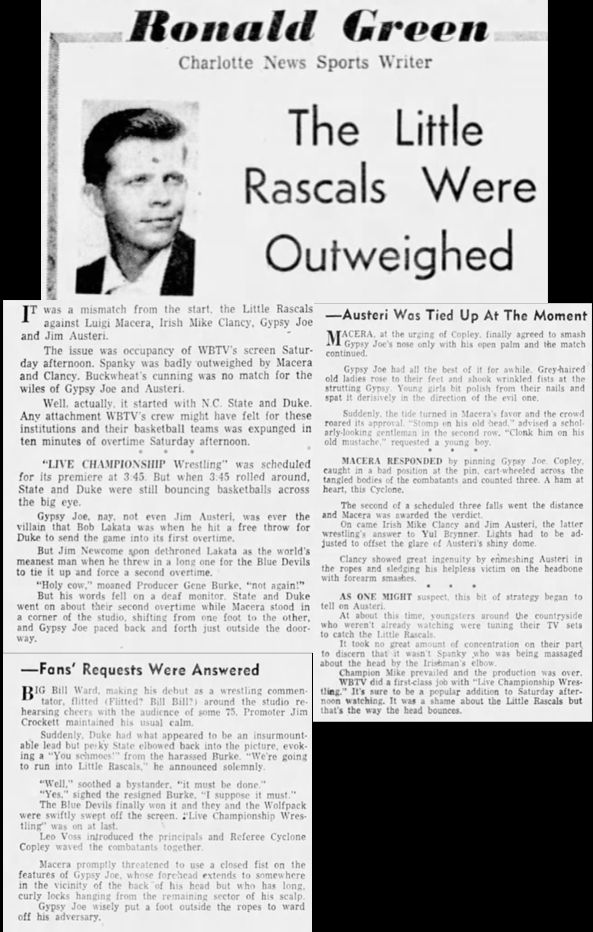
"Gypsy Joe, nay, not even Jim Austeri, was ever the villian that Bob Lakata was when he hit a free throw for Duke to send the game into its first overtime." - Ronald Green, Charlotte News

By Dick Bourne
Mid-Atlantic Gateway

If you grew up watching wrestling on TV on Saturday afternoons in the 1960s through the early 1980s, you knew full well the havoc traditional sports programming could cause with the schedule when they ran long, with basketball games going to overtime and baseball games going to extra innings.

On January 11 during the bleak midwinter of 1958, Jim Crockett was to debut his brand new live pro-wrestling show on WBTV channel 3 in Charlotte. It was a major development for promoter Jim Crockett to be able  to promote his local cards through the relatively new medium of television. Wrestling from Chicago, Los Angeles, and Texas had been a successful staple of national television in the 1950s, but this would be the local Crockett crew for Charlotte

Charlotte News sports writer Ronald Green wrote about that big news in the local paper in the week before. You can read that article in our earlier post here: "Championship Wrestling" debuts in Charlotte (1958)

The show, hosted by WBTV personality "Big" Bill Ward, did indeed debut on Saturday, January 11, but not at 3:45 that afternoon as originally scheduled. ACC Basketball got in the way. And then there were Spanky and those poor Little Rascals that got in the way, too.

In another Ronald Jordon column recently uncovered, the Charlotte News told the story. Read that entire article below for all the details.

The afternoon ACC basketball game between Duke and NC State ran long when Duke center Bob Lakata and forward Jim Newcome sent the game into two overtimes respectively. WBTV producer Gene Burke watched as the double-overtime contest threw his Saturday afternoon programming schedule into chaos, delaying the debut of "Championship Wrestling" and then, with wrestling running over, bumping the popular kids show "Little Rascals." 

It may not seem like much now, but one can imagine the stress producer Gene Burke and wrestling promoter Jim Crockett were under that afternoon with the debut of local pro wrestling on television. It was nice to read Ronald Green's positive nod to the production at the conclusion of the article.

As always, thanks to Mark Eastridge.

* * * * * * * * * *

ACC Basketball Note: Duke went on to win the ACC league championship that year finishing 11-3, a game ahead of second place NC State. Forward Jim Newcome, mentioned in the article above, went on to play in the NBA.

Tuesday, July 6, 2021

"Championship Wrestling" debuts in Charlotte on WBTV Channel 3 (1958)


by Dick Bourne
Mid-Atlantic Gateway

There was history in the making in this January 1958 Charlotte News article. Promoter Jim Crockett had finally arranged for televised wrestling in his home base of Charlotte, NC on the heels of successful national wrestling programs during the decade of the 1950s in such places as Chicago, Los Angeles, and in Texas.

The program would air live from the studios of WBTV channel 3 on Saturday afternoons and would be hosted by the station's sportscaster Bill Ward. The announcement was made by WBTV production manager Bob Rierson.

Crockett's first foray into televised wrestling was actually nineteen months earlier, on WFBC channel 4 in Greenville, SC, but for only about three short months. Perhaps this was a pilot program. Once wrestling made it's debut in Charlotte in January of 1958, it wasn't long before several other TV stations in Crockett's territory also began airing wrestling in partnership with the Charlotte promoter, including WRAL-5 in Raleigh, NC,  a return to WFBC in Greenville and the debut on WDBJ-7 in Roanoke, VA, both in 1960, and WGHP-8 in High Point (Greensboro market) in 1964. 

Crockett's wrestling debut on channel 3 was not without its challenges, however, having nothing to do with wrestling, but rather with ACC basketball. The results gave WBTV producer Gene Burke fits that January Saturday afternoon. We'll review that neat bit of history as well in a future post.

Republished in October 2022 on the Mid-Atlantic Gateway.

Monday, January 4, 2021

Promoter Pete Apostolou and Roanoke Wrestling

Pete Apostolou promoted many wrestling matches in the 1950s, 1960s, and 1970s, both on Saturday afternoon TV shows on WDBJ-TV (Channel 7) and in live evening venues such as the old American Legion Auditorium, Legion Stadium, and Starland Arena, seen here. (Roanoke Times Photo)


The following is an edited from a much larger article from the Roanoke Times by Ray Cox, originally published March 11, 2018. We extracted info about longtime Roanoke promoter Pete Apostolou for historical purposes, fleshing out some great detail about the old TV tapings that took place at WDBJ channel 7 in Roanoke.  Take time to read Cox's entire article on the Roanoke.com website here.
 

Professional wrestling has a rich history going back many decades from coast to coast, up into Canada and down into Mexico. A fondly recalled footnote involved the many Star City bouts promoted by Pete Apostolou on behalf of Jim Crockett Promotions.

WDBJ-TV (Channel 7) carried live studio wrestling Saturday afternoons from 1957-67. Early years of the show were staged on the second floor of the offices that still serve The Roanoke Times. Beloved WDBJ weatherman Hal Grant handled ringside blow-by-blow and post-match interviews. Apostolou was the color man. [The shows] were usually preludes to live evening bouts at venues such as the old American Legion Auditorium. More on the Bolos in a minute.

Eventually, in 1965 Apostolou bought an old bowling alley between Salem Turnpike and Shenandoah Avenue, dubbed it the Starland Arena, and continued Saturday night shows there. Apostolou thus had “the perfect set-up where the guys could come in and do the live ‘All Star Wrestling’ TV and the Starland Arena show all within hours of each other,” wrote Dick Bourne at Mid-Atlantic Gateway.

Another perfect setup for these weekend productions was that the touring grapplers would stay at the former Ponce De Leon Hotel on downtown Roanoke’s Campbell Avenue, right across 2nd Street from the Times-World building. Thus the beefy stars of the Saturday beating and banging matinees could wake up from their naps and walk to work.

Retired Roanoke newspaperman Bob Adams recalled the bad old days of Campbell Avenue head-busting. “The wrestlers would come up to the third floor rest room, which used to be right next to the sports department, to use as a dressing room,” Adams said. “On the second floor, they hated each other. They’d come up to the third floor, and be laughing and talking.”

Apostolou would take down the results of the bouts and bring them up to the sports desk, where editor Bill Brill, moonlighting as a publicist, would write up the press release, Adams said. At other times, one wrestling magazine or another would call into the sports department for results. Peeved copy editors, with regular newspaper deadlines looming, were as likely to make something up as give an accurate report, Adams remembered.

* * * * * * * 

Here is the link to the original story on the Roanoke.com website which includes greater detail, plus references to Jimmy "Boogie Man" Valiant and a deep dive into the Bolos via Gateway contributor Mike Cline. Great stuff from Ray Cox! (And thanks for mentioning the Mid-Atlantic Gateway.)

WOYM: Who were those masked wrestlers of the early days of Roanoke television?
By Ray Cox | Special to The Roanoke Times Mar 11, 2018 

https://www.roanoke.com/news/woym-who-were-those-masked-wrestlers-of-the-early-days/article_ae4cf29e-59f6-593b-bf1f-31051e4c65cc.html

Thanks to Kyle Rosser for making us aware of this particular column. This Studio Wrestling article was also published on the Mid-Atlantic Gateway. 

Friday, November 17, 2017

"Carolina Wrestling" featuring Claude Freeman (WFBC 1956)

By Dick Bourne
Mid-Atlantic Gateway
Originally published on the Mid-Atlantic Gateway 10/22/17

Carroll Hall, who publishes the "All-Star Championship Wrestling" website, has unearthed information on what most surely was Jim Crockett's earliest foray into televised wrestling.

In May of 1956, WFBC Channel 4 in Greenville, SC announced they would begin airing live wrestling matches in the studios of WFBC beginning on June 2, 1956. The show was called, appropriately enough, "Carolina Wrestling."

Here is the text of the announcement that appeared in the Greenville Times.

Channel 4 Will Have Wrestling Ring in Studio

Wrestling in the studios of WFBC-TV on Rutherford Street will be presented "live" by Channel 4 each Saturday afternoon from 4:30 to 5:30, the television station announced yesterday.

A 20 x 20 regulation ring will be set up in the spacious studios and name wrestlers will appear regularly. First performance will be next Saturday afternoon.

The wrestlers who have been scheduled to appear at various times include Mr. Moto, Kinji Shiduya, Gene Becker, Jack Whitzig, Don Arnold, Don Eagle, and Cheif War Eagle, Lea, Chick and Leo Garabaldi, Carl Von Hess, Dick Steinborn, and Angelo Martinelli. There will also be girl and midget wrestlers.

Commentator for the events will be Claude Freeman.

According to Hall's research of newspaper archival TV listings from that time period, the show ran for just over three months, with it's last appearance on the TV schedule being Saturday, September 8, 1956.

Demand for the free tickets to the studio show grew so quickly that on at least one occasion, WFBC moved the show to the famous Textile Hall in Greenville, site of many Jim Crockett wrestling events in the 1950s and 1960s. The move was reported in the Greenville Times to accommodate the huge demand for tickets to the live broadcasts.

WFBC-FM radio personality Claude Freeman was the host for the program. Freeman had been on WFBC-FM going back into the 1940s, hosting a popular morning program called "Kitchen Capers."

To put this show in historical perspective of the times, WFBC Channel 4 had only been on the air for two and a half years at this point, first broadcasting on December 31, 1953. Jim Crockett would not put wrestling on WBTV in his home city of Charlotte until January of 1958. So the June 1956 "Carolina Wrestling" show was bound to be the first ever affiliated with Jim Crockett Promotions.

The show proved to be quite popular, both in ratings and in interest for tickets, which begs the question why it was relatively short-lived. As reported on the Mid-Atlantic Gateway, wrestling would return to the studios of WFBC in Greenville in 1960 with hosts including Bob Poole, Bill Krieger and Billy Powell.

For Carroll Hall's first post on this information visit:
"Carolina Wrestling" on WFBC 4 in Greenville, SC"


http://allstarchampionshipwrestling.blogspot.com/2017/10/carolina-wrestling-on-wfbc-4-in.html

http://bookstore.midatlanticgateway.com