 |
| Paul Boesch on the famous Channel 39 set of Houston Wrestling with Nick Bockwinkel and Dusty Rhodes |
 |
| From: Fans of the original Houston Wrestling and Paul Boesch |
Paul Boesch Wrestling History (on Tim Hornbaker's LegacyOfWrestling.com)

|
| Paul Boesch on the famous Channel 39 set of Houston Wrestling with Nick Bockwinkel and Dusty Rhodes |
|
| From: Fans of the original Houston Wrestling and Paul Boesch |
Paul Boesch Wrestling History (on Tim Hornbaker's LegacyOfWrestling.com)


There were a number of broadcasting legends that hosted that show for promoter Jim Cornette, including Les Thatcher, Jim Ross, and of course the great Bob Caudle. My favorite broadcasting team for the promotion was Caudle with Dutch Mantell, with Caudle playing the straight man as always, calling it like a sports broadcaster would, and Dutch adding his controversial - -and often times hilarious - - commentary.
Dutch once spoke of his affection for Bob on his podcast, "Story Time with Dutch Mantell", remembering that Bob was the first wrestling announcer he remembers growing up in western North Carolina and watching Crockett Promotions wrestling out of Greenville, SC, and Asheville, NC. I'm imagining it was a thrill to be able to work with the "voice of his childhood."
*******************
See also: Dutch Mantell Remembers Working with Bob Caudle (with audio clip)
The following is a post by Georgia Wrestling historian Rich Tate from 2003 on the old Wrestling Classics message board. It is included here for historical purposes. [LINK]
More specific information about the period following Black Saturday in July of 1984 can be found on the Mid-Atlantic Gateway in the article Ole and Solie: The Evolution of TV Wrestling in Georgia after Black Saturday.
* * * * * * * 
RICH TATE: I am attempting to piece together a timeline for wrestling on TV in the Atlanta area. Can anyone make corrections or fill in gaps? Especially after Black Saturday...that's where my most confusion lies. Also, if anyone can add to it by adding in what may have been happening in Macon, Columbus, Augusta and Savannah, it's very much appreciated. (Bold and italicized text is mine.)
1954: Live Atlanta Wrestling first appeared on WLWA Channel 11 (ABC affiliate), a three-year-old station, hosted by Ray McCay, who had previously been doing the radio broadcasts of local shows on WQXI-AM 790. The show would jump around the schedule throughout its run on this station, and seemed to become an afterthought more and more as time went on. Prior to that, local fans could only see what the network feeds brought in, and more recently, the shows had been sent in via tape from Texas.
1955: Ed Capral, who had been the ring announcer, replaces McCay on Live Atlanta Wrestling.
1961: Channel 11 ownership changed hands, and its call letters became WAII.
1969: Once again, new owners took over at Channel 11, and the call letters became WQXI.
1970: On January 1, Atlanta independent UHF Channel 17 (WJRJ) is purchased by Ted Turner and renamed WTCG. Les Thatcher began working as a co-host and associate producer, a position he would hold for three years.
1971: Live Atlanta Wrestling changed its name to Georgia Championship Wrestling, beginning with the program shot on August 14. On December 25, Georgia Championship Wrestling aired for the first time on WTCG in a permanent time slot, with taping in the afternoon, and airing each Saturday at 6:00 pm. This was the reason the promotion decided to change stations. It had become very difficult to keep fans coming to the studios for live matches when the schedule was so varied at Channel 11.
1972: In June, WTCG begins re-airing its Saturday tape on Wednesday night as a prime time replay. This lasted until the fall. On December 2, WTCG began airing back to back episodes of Georgia Championship Wrestling and All-South Championship Wrestling in back to back Saturday evening slots. Capral changed over immediately to the All-South program, and Sterling Brewer was called in to cover the announcing for GCW, while maintaining his job in Birmingham for Nick Gulas’ show.
1973: Brewer was replaced on Georgia Championship Wrestling by Gordon Solie, who continued to do the announcing for Championship Wrestling from Florida out of Tampa. During the summer, Georgia Championship Wrestling shifted to morning hours to tape their programs.
1974: After the closing of All-South, Georgia Championship Wrestling continued on as the sole wrestling show on WTCG.
1976: A second program, called Best of Georgia Championship Wrestling, began airing on WTCG hosted by Freddy Miller. On December 17, WTCG became the second satellite-delivered cable program service (behind Home Box Office), and the first satellite superstation. The first Georgia Championship Wrestling show that could be seen beyond Atlanta was taped and aired on December 18.
1979: WTCG changed its call letters to WTBS on August 27, with the first Georgia Championship Wrestling show taped and aired on September 1.
1982: Georgia Championship Wrestling changed its on-air name to World Championship Wrestling.
1983: A co-promotion initiated between Ole Anderson and Jerry Jarrett called GCW Superstars aired for three months on WTBS, produced and hosted by Les Thatcher.
1984: On July 7, the final episode of World Championship Wrestling taped and aired on WTBS, and fans were introduced to WWF programming the following week. The WWF debuted on July 14 in WCW’s former time slot, on a day that has been dubbed by fans as “Black Saturday.” In September, a new promotion operated by Ole Anderson and Ralph Freed got an early morning time slot on WTBS each Saturday. The promotion and the show were both called Championship Wrestling from Georgia, and Gordon Solie was back as the announcer. Meanwhile, Turner sold a Sunday night time slot on WTBS to Mid-South Wrestling, hosted by Jim Ross.
Gateway Note: More specific information about the period following Black Saturday in
July of 1984 can be found on the Mid-Atlantic Gateway in the article Ole and Solie: The Evolution of TV Wrestling in Georgia after Black Saturday.
1985: Jim Crockett bought the Championship Wrestling from Georgia business and time slot on WTBS, and began airing World Championship Wrestling on the time slot he purchased from Vince McMahon. This version of the program was hosted by David Crockett and Tony Schiavone.
Joe Pedicino began producing and hosting a show on WATL Channel 36 (Independent) that aired each Saturday night, starting at 8:00 pm. It lasted through 2:00 am, and showed tapes from various promotions around the world in their entirety.
Some responses are included below with additional or clarrifying information.
[A] KING COMBO:
1983: A co-promotion initiated between Ole Anderson and Jerry Jarrett called GCW Superstars aired for three months on WTBS, produced and hosted by Les Thatcher."
AFAIK, didn't the full shows only air in Chattanooga (where the show was taped), and only selected matches aired on the Sunday show w/ other GCW footage?
"1984: On July 7, the final episode of World Championship Wrestling taped and aired on WTBS, and fans were introduced to WWF programming the following week. The WWF debuted on July 14 in WCW’s former time slot, on a day that has been dubbed by fans as “Black Saturday.” In September, a new promotion operated by Ole Anderson and Ralph Freed got an early morning time slot on WTBS each Saturday. The promotion and the show were both called Championship Wrestling from Georgia, and Gordon Solie was back as the announcer. Meanwhile, Turner sold a Sunday night time slot on WTBS to Mid-South Wrestling, hosted by Jim Ross."
The show was still called World Championship Wrestling (in the intro and on the studio banner) after Black Saturday. The "coming up next..." slates on TBS still referred to the show as Georgia Championship Wrestling, as did Gorilla Monsoon. The show had original interviews at this point but no original matches.
It is worth noting that of the 3 shows, Mid-South drew the highest ratings (making it the highest rated show on cable at the time).
"1985: Jim Crockett bought the Championship Wrestling from Georgia business and time slot on WTBS, and began airing World Championship Wrestling on the time slot he purchased from McMahon. This version of the program was hosted by David Crockett and Tony Schiavone.
Joe Pedicino began producing and hosting a show on WATL Channel 36 (Independent) that aired each Saturday night, starting at 8:00 pm. It lasted through 2:00 am, and showed tapes from various promotions around the world in their entirety."
Somewhere in February-March, the WWF buckled to Turner's pressure and moved the W/GCW show to the studio on Techwood Drive for its own tapings w/ Gorilla Monsoon as host and Freddie Miller as ring announcer. This lasted about a month or so before the slot was sold to Crockett. These tapings featured the studio returns of Mr. Wrestling II & Roddy Piper.
"1986: Ann Gunkel starts a second version of All-South Championship Wrestling that aired for several weeks on WANX Channel 46 (Independent), hosted by Les Thatcher."
I believe this was the year of the first showing of the "History of Atlanta Wrestling" special on WATL, along w/ the first Wrestlethon (24 hours of various footage hosted by Pedicino w/ phones manned by wrestling personalities taking donations for local charities). Wrestlethon '88 featured the return of live studio wrestling in Atlanta, w/ several matches done at WATL, and a feature on the Fox Network's late show.
Someone else probably knows more about North Georgia, SCW, NWA Georgia/Wildside, etc.
[B] RED MASK: Rich, Championship Wrestling From Florida w/Gordon Solie aired on WTCG Channel 17 Saturdays at 7pm right after GCW at 6pm around late '74/'75 after All-South went down.
[C] CINCINNATI KID: wish I could give you more information on the wrestling on TV in Atlanta. I do note that the station that initiated the shows was WLW-A, which was owned by the Crosley Broadcasting Company's division of Avco. It was that same company who started TV wrestling in Cincinnati on WLW-T, then on Channel 4, on February 4, 1950. In time, the Crosley affiliates in Dayton, Ohio - WLW-D, Channel 2, and in Columbus - WLW-C, Channel 4, (after the Cincinnati station moved to Channel 5), all began carrying matches from the Al Haft promotion. Matches were aired on Saturday afternoons and Saturday nights. By the early 1960's, even WLW-I in Indiapolis was airing TV matches of the Haft promotion out of Dayton with the other WLW stations likewise picking up the feeds. As with other programming and in the area of engineering, Crosley was always at the forefront.
On May 6, 1967, LIVE ATLANTA WRESTLING celebrated its 13th anniversary on the air on channel 11, WAII-TV. The occasion was mentioned in a short blurb a day earlier in the Atlanta Journal-Constitution newspaper.

GEORGIA RINGSIDER, the official program for Atlanta wrestling in the 1960s and 1970s, featured an article about the anniversary in the program for the Friday night matches at the City Auditorium on May 5, 1967. It spotlights the Atlanta studio wrestling show, as well as the host of that program, ED CAPRAL, who later hosted WIDE WORLD WRESTLING for Jim Crockett Promotions from 1975-1978.
From GEORGIA RINGSIDER, Friday May 5th, 1967
Tomorrow, May 6th, marks the 13th anniversary of "Live Atlanta Wrestling", telecast each Saturday at 6:30 PM on channel 11, WAII-TV.
The studio wrestling program, which was first presented in 1954, was the first live TV wrestling program ever aired in the south.
The popularity of the program has been evidenced over the years by a long list of national and local sponsors, plus good audience ratings by various national surveys. One recent survey, the ARB STUDY, showed the program with over 105,000 homes each week, and over 230,000 persons tuned in.
Ed Capral, host of the televised bouts, has been a regular on the program since 1955, as well as regular ring announcer at the auditorium. Each week he is assisted by such wrestling experts as Ray Gunkle, (Paul Jones, and referee Leo Garibaldi.
Except for news shows, "Live Atlanta Wrestling" is the oldest live program on the air on all three TV stations in Atlanta, a tribute to you, the fans who support the program, the Friday night matches, and the sponsors.
Each Saturday, during May, special bouts are being signed for TV as part of our 13th Anniversary month. Join us tomorrow at 6:30 PM as we begin our 14th big year.
 |
| "Live Atlanta Wrestling" host Ed Capral |
ED CAPRAL HISTORY IN THE MID-ATLANTIC AREA
Ed Capral was the inaugural host of the program WIDE WORLD WRESTLING for Jim Crockett Promotions from 1975-1978. The show was taped at the WRAL TV studios in Raleigh, NC, and syndicated throughout the Carolinas and Virginia.
Prior to coming to work Jim Crockett Promotions, Capral was the longtime host of LIVE ATLANTA WRESTLING, an hour long program that aired most every Saturday on channel 11, WAII, in Atlanta. The show was also syndicated to other stations throughout the state of Georgia a week later. He was with the program from 1955 until the Atlanta promotional wars of the 1970s, where he left the NWA promotion to work for the upstart "All-South Wrestling", promoted by Ann Gunkle. When All-South folded a year or so later, Capral was without a job. As it happened, Crockett Promotions was launching a new wrestling program, and they recruited Capral to host it.
Crockett Promotions released Capral after his three year deal was up in 1978, mainly because it was expensive to fly him to Raleigh from Atlanta every Wednesday when they taped TV. He was replaced by Rich Landrum, the ring announcer in Richmond for many years who was willing to make the drive from Richmond to Raleigh each week. The show got a name change to "World Wide Wrestling" at that time.
AUDIO TAPE MEMORIES
If you've followed the Mid-Atlantic Gateway (the parent website to this blog) for any length of time, you know about David Chappell's extensive collection of audio tapes of Mid-Atlantic Wrestling from 1974-1983 before he got his first VCR. So we always enjoy hearing stories about folks that recorded wrestling on audio cassette before the advent of home video recorders.
This is a great memory by Danny Goodard, posted on Rich Tate's old Georgia Wrestling History Forum, who recorded wrestling on reel-to-reel tape on the 1960s:
I used to tape "Live Atlanta Wrestling" with Ed Capral on Saturday nights because my Dad worked at the old Atlanta post office and I would play it for him during breakfast on Sunday morning. Cassette tapes had not been invented. I used a little portable reel-to-reel tape recorder, hanging the microphone on the knob of the TV! [LINK]
We love that!
Edited 2/21/2026
The following is a transcript of a portion of a 6:05 Superpodcast interview with Bobby Simmons, a key office employee (as well as a referee) for Georgia Championship Wrestling going back to the "wrestling war" days of the early to mid 1970s. In fact, Bobby got into the business working for Tom Renesto and Ann Gunkle of All-South Wrestling, the group that split off from the NWA. Simmons was the only person that worked for Gunkle that was immediately given a job with the NWA group, at that time run by Jim Barnett and booked by Harley Race. He was a valued member of both teams.
Here, Bobby talks about the other long-forgotten TV shows in Georgia that were produced by promoter Fred Ward, who ran the towns of Columbus, Macon, and Albany. Ward had his own TV shows, booking the talent from the main Georgia office out of Atlanta. This subject has always been of interest to me, but little was known about it outside of folks that were there at the time. Bobby shed some major light on both "Columbus Championship Wrestling" and "Macon Championship Wrestling."
****
Bobby, you mentioned earlier that on Saturdays you had Atlanta TV in the morning and then you had Columbus TV later in the day at the Columbus Sports Arena. At some point during the week, you also had Macon TV – what was the schedule like with TV’s, and how hectic was a Saturday with both of those TV tapings and – correct me if I’m wrong – that’s over 100 miles apart: Columbus to Atlanta.
Bobby: From downtown to Columbus – probably 118, maybe. Something like that. It was not interstate back then, either. It was not an interstate that went all the way to Columbus; there is now, wasn’t then. The police knew in all those little small towns – we’d be coming through there and they’d watch for us. We were, uh – after Gunkel went out of business and we were Georgia Championship Wrestling, we taped 2 hours on Saturday morning. It was supposed to start at 10 o’clock and be over shortly after noon. If that was the case, you could get out of there – you would be to Columbus by 3/3:15 and then you had 45 minutes until the show started, and it was live; there was no tape. So, but that was never the case, because it never started on time, and there was always some sort of technical glitch between shows that would slow you down – from starting the second hour. You would get out of there – I had gotten out of Atlanta TV as late as 2 o’clock, and have to be in Columbus. I had actually walked through the sports arena in Columbus, GA, throw my bag over the counter to the guy running the concession stand, and went to the ring, because the guys were on their way to the ring, and they were gonna use another wrestler for a referee, and as I walked in, he’d peel off and I’d go to the ring. I’d find out from the guys in the ring what we were doing.
And that was live TV, Columbus, right?
Bobby: It was live TV. It was that close. Mr. Ward and Ralph Freed – his son-in-law – and Leon Ogle – who was his son-in-law, Ralph worked in the office and Leon – Leon actually booked for Mr. Ward for a number of years. He – oh, they would pull their hair out. They’d go crazy, sitting there waiting. You’ve got a live TV show, you’ve got no wrestlers, you’ve got no referee, and we’re all on the road trying to get there, but we could not leave Atlanta until we got through the Atlanta TV, and it was very close sometimes. Macon TV was on Thursday afternoons when I first started working for them. It was done from, like, 1 to 2 or 2 to 3; it was in the afternoon. I can’t remember exactly what time it started, but we were running Savannah, GA – which was another 175 miles south of Macon – and you had to, you couldn’t leave until you got through with that TV, so it made you push to get to Savannah on time. So that was those TV’s. One other TV they did for a while – we used to tape a TV at the Atlanta Wrestling Office; was in the old Atlanta Sports Arena and for years was used as a back-up to the Auditorium. If you couldn’t get the auditorium. They eventually started doing a TV there where they would – it was for Macon, it was for Albany, it was for Augusta, it was so we could send in the different tape other than that Atlanta TV tape, and we did that for a while on Tuesday afternoons. There again, sometimes we wouldn’t get out of there until 4 o’clock, and if you had to go to Albany that night, you had about 20 minutes to grab a hamburger and hit the road. So, it was – the TV, that was the TV’s we did, and they were, you were always pressed to get wherever you were going when you got through with them. The only time you weren’t in a hurry was after Columbus TV: because it was live, it was over at 5 o’clock, so you had 2 and half hours to get where you were going Saturday night, and the two towns we ran on Saturday were back toward Atlanta, so it wasn’t bad getting to those. You actually could sit down and eat a meal on Saturday night on the way.
Now, I guess since we’ve, you know – we’re a little younger and not from the area, basically – so we’ve never seen the Columbus or the Macon TV; just a couple matches. I mean, no more than 5. Describe for us…was it formatted differently at all? Were the angles that different, or did the programs overlap between the three shows? How exactly did that work?
Bobby: Well, you know, Fred Ward was - the Macon TV, the Columbus TV were his. There were times when Mr. Ward – as I’ve said, Leon Ogle, who was Fred’s son in law – booked Fred’s towns for a while and he did his own angles. Everything they did there was geared for Columbus, for Macon, for Albany. They would – angles were different, the top guys could be different, even. Bob Armstrong – I’m sure you’re familiar with, Bullet Bob. He wrestled for Continental, he’s been all over. But Bob and a guy named Bill Dromo – who, great friend of mine, but Bill was never a top guy here in Atlanta. They always used him opening to middle of the card, but in Columbus, Mr. Ward used Bill and Bob on top. They were like saints in those towns – people loved them in those towns, because Mr. Ward built his own angles and did his own thing! There were times that they would use the Atlanta booker to book the towns and run the whatever – lot of times it’d be a continuation of whatever we’re doing anywhere else. Columbus TV was filmed in the old Sports Arena in Columbus, which was an old warehouse. Someone told me it was used for a mule barn at one time, but it had bleachers. It would hold about 2000 people, they charged a dollar a piece to get into the live TV show on Saturday. They always drew 4/500 people, and if the Auditorium was unavailable, they would run Wednesday night house shows in the sports arena, so it was a good sized building. Macon TV was in a studio, and they were – that’s pretty much how it worked. Those tapes – those Columbus tapes – rumor has it they’re still around, but they’re salted away and they’re afraid to dig ‘em out and try to sell ‘em or do anything with them. They’re afraid that Vince might claim he owns them too, so, you know. Nobody thinks he does, but, you know – our lawyers are bigger than your lawyers, so I guess they’re afraid to try. Some of those Columbus tapes probably still exist.
Source: 6:05 SuperPodcast Wiki
https://605-superpodcast.fandom.com/wiki/Bobby_Simmons
See also: Man Behind the Mike: Jim Carlisle (Georgia)
Carlisle hosted both the Columbus and Macon TV shows.
https://studiowrestling.blogspot.com/2016/04/man-behind-mike-jim-carlisle-ga.html
(from Wrestling News Magazine, 1966)
One of the most widely known of the TV wrestling announcers and a dean among all sportscasters is genial Ray Morgan who is the man behind the mike at the weekly shows from the Nation's Capital, Washington, D.C.
Ray, who has been doing wrestling on a regular basis since 1957, has been in the broadcasting business for over thirty years, starting out in 1933 on radio station WETL in Philadelphia.
Born in Trenton, N.J, and raised in the small town of Libertown, Md., Ray was headed for a law career at Notre Dame following his graduation from Atlantic City, N.J. high school. However, as this was during the height of the depression he had to give up his dream of college to go to work. After holding down a few selling jobs he decided to take a crack at the broadcasting business.
 |
| Ray Morgan with Bruno Sammartino |
Morgan applied to station WCAU in Philadelphia, but was told to get some experience. He worked without pay for the next six months for WETL, a small station in Philadelphia, but never got to WCAU. Instead he moved on to WPG in Atlantic City. Morgan remained there for seven years, becoming chief announcer and sports director. When the station went off the air on New Year's Eve in 1940 Ray swiched to WWDC in Washington where he took over the post of chief announcer.
Morgan failed in an attempt to enlist in the service but put in four years working for Uncle Sam as a public relations officer at the Miami Air Force Base. After the war he returned to WWDC as sports director and head of the special events department. He moved into TV a few years later and in 1952 joined WTOP. Later he became sports director of WTTG-TV where he began his career as a wrestling announcer. Ray's warm and friendly manner made him an instant hit with the fans. The mailmen groan under the heavy load of fan mail that reaches his office every day.
Some years ago Ray was seen twice weekly with shows coming from Bridgeport, Conn. as well as Washington, D.C. but now he has only one show out of Washington which is seen in many cities throughout the United States. Tapes of these shows appear in Europe and Africa thus making him a world-wide personality.
Morgan has made thousands of personal appearances in recent years but no matter what the gathering or what subject he is scheduled to talk about, it always ends up being wrestling. Ray loves the wrestling fans. "They are the most loyal and rabid of any sports fans, but they get out of hand sometimes, "he chuckled.
Morgan has watched just about all the greats of matdom in action and has seen fads and fantastic followings come and go for the wrestlers, but he remarked, "I have never seen a wrestler with the loyal following that Bruno Sammartino has. Bruno is a true gentleman and this is the reason I feel he has become such an idol. It is not only his great ability that has made him the star that he is."
 | |
| Jerry Lawler confronts NWA World Champion Ric Flair in Memphis. |
As far as we're aware, this was Ric Flair's first and only appearance in the WMC channel 5 studio in Memphis where Championship Wrestling was taped every Saturday morning in the 1970s and 1980s. The date was August 14, 1982.
In the image above, host Lance Russell holds the mic as Lawler confronts Flair. Co-host Dave Brown can be seen in the background sitting at the Championship Wrestling broadcast desk.
Flair defended the NWA title against Lawler in a spur-of-the-moment agreement for a 10 minute time limit match. At the ten minute mark, Flair was in control with the figure four leg-lock, but Lawler would not submit. Flair, wanting to defeat the local legend on television in his hometown, demanded 5 more minutes. Lawler rebounded and had the upperhand, including hitting Flair with his famous fist-drop from the corner turnbuckle. Flair bailed out and was counted out of the match giving Lawler the countout victory, but not the NWA title.
The entire confrontation and title match can be found as a bluray extra on the WWE production of "It's Good to Be the King: The Jerry Lawler Story."
Video featuring Flair's interview, the confrontation, the match, and the post-match can be found on YouTube at the links below.
Video Links
Part One: The Interview
Part Two: The Hustle
Part Three: The Match
Part Four: The Meltdown
Wrestling Ring Is Homemade
Roanoke Times, September 23, 1961
Ch. 7's new regulation-size wrestling ring is a masterpiece of sturdy, yet intricate building engineering.
Built to professional specifications, the ring measures 18 feet square, with flooring of three-quarter inch plywood, covered with a foam rubber cushion one inch thick, and with a finished surface of canvas.
Support for the ring is provided with 2x10-inch timbers spaced two feet apart, with eight-foot corner posts of white oak eight inches square.
The ropes enclosing the ring are cable, covered with a good grade of rubber hosing tightened by means of turnbuckles which are fastened to the corner posts.
The ring is designed for easy disassembling, since it is connected with five-eighths-inch bolts, and can then be placed on dollies and rolled to storage in the adjoining prop room. Each Saturday evening after "Wrestling From Roanoke," the ring is disassembled and stored until the following week's match.
The construction of the ring is the handiwork of Charles Verna, of the WDBJ-TV staff, with the help of an assistant.

Johnny Weaver told us that WDBJ pulled the show following an ugly on-air racial incident between Ike Eakins and Luther Lindsay. This took place in early January, 1967.
For nearly six months, Roanoke promoter Pete Apostolou was without television wrestling to support his weekly cards in Roanoke, as well as surrounding towns including Salem and Lynchburg, VA. Gates suffered during this time.


This information flyer was apparently given to local event promoters throughout the Carolinas and Virginia in hopes of JCP to expand their "spot shows" in the region. It touted the burgeoning television presence of Jim Crockett Promotions professional wrestling television shows that would help these promoters build their gates. The local promoters would book their talent from Jim Crockett out of Charlotte.
At the point in time this graphic was published (late 1959 or very early 1960), Crockett had live TV already being taped and aired in Charlotte, Raleigh, and Roanoke, with High Point NC and Greenville SC soon to follow. What isn't clear is if Crockett hoped to have additional live or live-to-tape locations at the other stations listed on this flyer, or if they were to simply carry a tape from one of the other live shows.
Some notes on the television stations featured here:
WBTV Charlotte NC
Jim Crockett began airing live wrestling on Channel 3 in Charlotte in January of 1958. The program, called simply "Championship Wrestling" was live at first and later would be taped and aired on a slight delay.
WFBC Greenville SC
Channel 4 in Greenville actually began airing live wrestling from its studio in 1956, nearly a year and a half before WBTV did in Charlotte. That first foray lasted only 3 months. It appears it was the very first television for Jim Crockett Promotions wrestling. WFBC's second attempt at live wrestling came in March of 1960, just a month later than this graphic indicates the start date would be for TV wrestling in Greenville. That second stint of live studio wrestling ended in December 1961. At that point, WFBC began carrying the tape from Raleigh.
WRAL Raleigh NC
Channel 4 in Raleigh began airing its own live studio wrestling in January of 1959, one year after the WBTV tapings began. Most other TV stations in the growing JCP network carried the tape from Raleigh, titled "All Star Wrestling." Fourteen years later, WRAL would be the site where all JCP televison production would be consolidated.
WDBJ Roanoke VA
Channel 7 in Roanoke began airing live wrestling from its studio in 1960, where it lasted for local promoter Pete Aposolou for seven years, when they began carrying the Raleigh tape.
WFMY Greensboro NC
While live wrestling may have been planned for WFMY channel 2 in Greensboro in June of 1960, it appears it never came to fruition. In fact, it appears WFMY never carried a Crockett tape at any point. (We welcome new information.) Another TV station in that same DMA market, WGHP channel 8 out of High Point, began airing its own live-to-tape studio wrestling for Jim Crockett in February of 1964. That lasted until the great consolidation to Raleigh in 1974.
Richmond VA
At the time of this information flyer, it seems clear JCP wanted to have a live TV presence in Richmond, similar to WBTV or WRAL, to support the work of long time Richmond promoter Bill Lewis, now working with Jim Crockett in Charlotte. No doubt Lewis was working to secure an arrangement with a station there, but it never happened. Lewis died in 1961. WTVR channel 6 eventually became the station that would carry the wrestling tape from Raleigh NC on its airwaves for decades. By that point, both Raleigh and Richmond were promoted by Raleigh promoter Joe Murnick, working for Jim Crockett.
WNCT Greenville NC
WECT Wilmington NC
Apparently both of
these stations were to begin carrying a tape from JCP in 1960, with the
tentative date being that June. By the 1970s though neither station
would be carrying a Crockett tape. The Wilmington station would
eventually be carrying the Championship Wrestling from Florida show. More information is needed on these two stations listed here.
We are also looking for information on Jack Partlow and Hal Van Horn listed as contacts in Charlotte on this information flyer.
Thanks to Scott Teal for originally sending this image to us.
HOME | MID-ATLANTIC BOOK STORE | STUDIO DIRECTORY
ABOUT | CONTACT | MID-ATLANTIC GATEWAY
Visit the DESKTOP VERSION
of the website for lots of FILTER OPTIONS to find info on your favorite
announcer or studio location. Filter options are located on the right
side of the web/desktop version of the website.

This TV Sports listing from an August 1974 edition of TV Guide (East Tennessee/Carolina edition) is chock full of wrestling shows from several territories, including Mid-Atlantic, Knoxville, Memphis, and All-South Wrestling.

Here are some specifics and context:
At 1:00 PM on WFBC-4 from Greenville, SC it was Mid-Atlantic Championship Wrestling, hosted by Bob Caudle in the same traditional time-slot in appeared in for decades. Up until recently, the show had been named All-Star Wrestling until promoter John Ringly (a top lieutenant for Jim Crockett, Sr.) came up with the Mid-Atlantic name.
At 2:00 PM on WKPT-19 in Kingsport, TN, was likely an edited version of the Memphis show hosted by Lance Russell, simply titled Wrestling as I believe Kingsport was run by the Jarretts at this time.
At 2:30 PM on WBTV-3 from Charlotte, NC, was Championship Wrestling with Big Bill Ward from the WBTV studios. Just a month or two later, all of Jim Crockett's TV wrestling would be consolidated to Raleigh in the studios of WRAL-5.
At 2:30 on WJHL-11 out of Johnson City was likely the old Knoxville show Wide World of Wrestling hosted by Big Jim Hess, which was promoted by John Cazana, just prior to Ron Fuller's buying of the territory, which was in late 1974.
At 3:00 PM on WRET-36 from Charlotte, it was Mid-Atlantic Wrestling hosted by Bob Caudle, (a rare time when the show was identified as such in TV guide!) This was the Raleigh show, since channel 3 was still producing their own studio show, which, as mentioned above, was soon to end.
At 6:30 on WTVK-26 from Knoxville was Wide World of Wrestling hosted by 'Big" Jim Hess, the locally-taped Knoxville show promoted for years by the Cazana family until purchased by Ron Fuller in late 1974. It was loosely affiliated with Gulas promotions out of Nashville, from where they booked a lot of talent. Soon after buying the territory, Ron Fuller would move the taping of his show to WBIR-10 in Knoxville, rename it Southeastern Championship Wrestling, and hire Les Thatcher to host.
Also at 6:30 on WRET-36 in Charlotte was All-South Wrestling, the non-NWA "outlaw"show promoted by Ann Gunkle and hosted by Ed Capral, the previous longtime host of Georgia wrestling in Atlanta. All-South would soon go out of business, and Capral was hired by Jim Crockett, Jr. to host his brand new Wide World Wrestling syndicated show out of Raleigh in 1975.
Finally at 11:15 on WLOS-13 from Asheville was Championship Wrestling with Charlie Harville, which was a Jim Crockett Promotions show that originated from WGHP-8 in High Point, NC. Similar to the WBTV Championship Wrestling show from Charlotte mentioned above, this show was soon to end when all of Crockett's TV would consolidate to Raleigh. At that point, WLOS would switch to the Mid-Atlantic "B" show hosted by Les Thatcher out of Raleigh. This time slot (soon to move fifteen minutes later due to the local news expanding to a half-hour) was the traditional WLOS time slot for many years.
HOME | MID-ATLANTIC BOOK STORE | STUDIO DIRECTORY
ABOUT | CONTACT | MID-ATLANTIC GATEWAY
Visit the DESKTOP VERSION
of the website for tons of FILTER OPTIONS to find info on your favorite
announcer or studio location. Filter options are located on the right
side of the web/desktop version of the website.
To A Sixth Grade Wrestling Fan, No one Could Top the Great Bolo
by Vince Staten
Kingsport Times News (Kingsport, TN) April 8, 2007
There comes a time in every young man's life when he falls in love.
With wrestling.
My love affair with professional wrestling came in late grade school when I was too old to play cowboys and not old enough to be interested in girls.
I was reminded of this boyhood fascination when I drove past the Civic Auditorium this week and saw "Championship Wrestling" posted on the signboard. I went home and dug around till I found my old wrestling sheet.
Not only did I live and die with each week's matches that sixth-grade year, I came up with my own highly scientific rating system based strictly on whether I liked a wrestler or not.
 |
| The Great Bolo (Publicity Photo) |
I had rank ordered 40 wrestlers from Argentina Rocca, Billy "Tarzan" Darnell and Buddy Rogers to my favorite, The Great Bolo. (He was seventh; I was fair and balanced.)
We've had professional wrestling in Kingsport as long as we've been a town.
I've seen ads for wrestling matches in old newspapers from the 1920s. In the 1950 and 1960s Ron Wright and Whitey Caldwell ruled the ring at the Civic Auditorium.
I wasn't allowed to go - too dangerous, my mother said - so I fell in love with that other form of professional wrestling, studio wrestling.
The "studio" of studio wrestling was the television studio. And because the Kingsport cable system in the 1950s imported stations from Knoxville and Charlotte and Asheville, we had our choice of Saturday afternoon studio wrestling.
There was a filmed show called "Texas Rasslin' " that featured Gorgeous George, a bleach blond who preened as much as he wrestled. (It was my grandmother's favorite wrestling show.) I preferred "Championship Wrestling" from WBTV in Charlotte because it featured the greatest variety of wrestlers, from "scientific" types like George Scott to out and-out thugs like Buddy "Nature Boy" Rogers who had a standing offer of $1,000 for any fan who could break his Figure Grapevine Hold.
And no one ever did.
It was a different era for wrestling. Today wrestling prides itself on being "entertainment," but in those days it called itself a sport, and questioning whether wrestling was fake - a popular question, incidentally - was asking for a poke in the nose.
In my neighborhood, we always made sure our Saturday baseball games were over by 5 p.m. so we could all gather around Mr. Brickey's Philco to watch studio wrestling from Charlotte.
The announcers were just as famous as the wrestlers. Calling the action was Big Bill Ward, a debonair fellow with a mustache in a time when almost only debonair men had mustaches, and the commentator, who was also the promoter, Jim Crockett. He was the one who should have had "Big" in front of his name.
Each Saturday show had two matches, an individual match and a tag team contest. It was always good versus evil, which is blood-sport for a sixth-grade boy. Evil P.Y. Chung, he of the famous "Claw" hold, might take on good guy Sandy Scott, of the wavy blond hair.
I, of course, always rooted for Good. Except for one, The Great Bolo.
It started with the name. How could you not love a wrestler named Bolo?
And then there was the costume. The Great Bolo was the first masked wrestler I had ever seen. He wore a skin-tight mask that laced up the back. It had dark shading around the eyes and mouth that would have made it almost clown-like if Bolo hadn't been so ferocious.
He could be wrestling along, working his Sleeper Hold on an opponent, when he would hear a disparaging remark from Big Bill Ward, and he would leap the top rope, race over and challenge the announcer. Blows were never exchanged, but it was exciting anyway.
Even that wasn't the greatest appeal of The Great Bolo. No, what we all watched for and hoped for was a Bolo defeat. Anyone who defeated The Great Bolo would get to unmask him. Right in the ring.
And that's what we all really wanted to know: Who was The Great Bolo? Was he secretly a good guy like George Becker who flirted with the dark side? Was it Nature Boy Rogers moonlighting for extra cash? Hmm, you never saw them together.
There were weeks when The Great Bolo's opponent might get his mask halfway off. I seem to recall Mike Paidousis had it up over his chin once. But Mike was too concerned with the mask, and Bolo managed to grab him and do the Pile Driver.
The Great Bolo was never unmasked on "Championship Wrestling.”
I later heard that he had been defeated in Toronto or someplace like that and his real identity was revealed. Some kid had read about it in "Boxing News/ Wrestling Illustrated."
By then I didn't care. I had discovered girls.
Vince Staten's blog can be found at vincestaten.blogspot.com.
HOME | MID-ATLANTIC BOOK STORE | STUDIO DIRECTORY
ABOUT | CONTACT | MID-ATLANTIC GATEWAY
Fresh off my post about the monster TV ratings for JCP in Charleston, SC in 1978, here is another article about the strength of Crockett programing in that same year, this time in Charlotte, NC.
PRO WRESTLING ENDURES,
PROSPERS WEEKLY ON TV
By Mark Wolf
The Charlotte Observer, March 25, 1978
Crunch. Slam. Piledrive. Thud. Smack. Kick. “You turkey neck.” Sleeper. Pin.
Professional wrestling is on the air.
The cast changes, heroes and villains arrive and depart, the belts, symbolic of myriad championships, change hands and the sport itself is given the back of the sports establishment’s hand. But televised professional wrestling endures; no, it prospers.

The one-hour show, which airs Saturday afternoon on Channel 3 (the time varies) was watched in 63,000 households during a recent ratings period. A similar show, Wide World Wrestling, is shown at noon Saturdays on Channel 36 (WRET) and drew 43,000 households in the same period.

“It probably enjoys the longest continuing run of any program on television,” says WRET station manager, Dave Uhrich. “I can’t think of any other syndicated show that’s been on that long except maybe some religious show.”
Charlotte promoter Jim Crockett produces and packages both programs and provides them free to the Charlotte stations and 22 other stations in North and South Carolina and Virginia. Crockett gives the show away in return for commercial time during the broadcasts to promote the live wrestling shows he stages in the three states. He also sells the show to stations in West Virginia, Georgia, Texas, Florida, Pennsylvania, Michigan and Kansas.
The wrestling show is an everybody wins situation. Crockett gets an hour’s promotion for his arena shows, and the stations get not only free programming, but can sell commercials during the show.
“Because television is seasonal, there are not commercials in all of the slots that are available,” says WBTV program director John Hutchinson. “Actually, we have movies we could make more money from, but we have a need for a wrestling program. The ratings are very good. If we weren’t getting that particular show, we would go out and look for another one.”
“It (wrestling) appeals to so many different levels. The nostalgia of people who watched it when they were kids, the morality play element of good against bad, the football fan who likes to sit in his armchair and work out his aggressions, older people, kids, it cuts across all strata. With everything else changing in society, wrestling has always been popular on TV. There’s something going on there, something that taps a need in a lot of different people.”
According to Crockett, the show outdraws Wide World of Sports, NCAA Football and NCAA Basketball. “In Greenville, SC, we delivered more adult males than ‘Starsky and Hutch’ or ‘Kojak’, and they’re in prime time.”
Crockett’s shows, produced before a live audience every Wednesday night in the Raleigh studios of WRAL-TV, are technically proficient and include slow-motion replays of winning maneuvers. (“Let’s have another look at that figure four leglock, Bob.”)
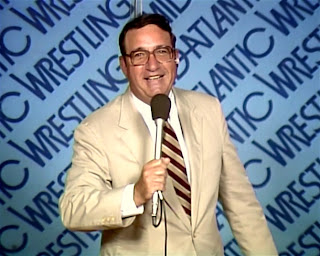 |
| Bob Caudle |
Bob Caudle, now a WRAL salesman, formerly an on-air personality, and Crockett’s brother, David, announce the Mid-Atlantic (Channel 3) program. Former wrestler George Scott hosts the Wide World (Channel 36) version with a guest commentator – usually a wrestler, but occasionally Jim Crockett. (“Boy, do I hate doing that,” says Crockett.)
The same corps of wrestlers appear on each show. The format includes four or five matches interspersed with interviews. The interviews afford the wrestlers an opportunity to develop their personalities, bad-mouth upcoming opponents, and hype the next live show. Interviews promoting matches in each market area are spliced into the tape which goes to the station in that market.
Generally, a headline wrestler (Ric Flair, Greg Valentine, Wahoo McDaniel, Ricky Steamboat, or the like) opposes a lesser light. Occasionally, though, Crockett matches a pair of headliners. Recently, Valentine captured the Mid-Atlantic championship from McDaniel on TV and broke Wahoo’s leg in the process.
Whether wrestling is real, semi-real or a complete sham is beside the point (says Crockett). “I don’t believe anybody has ever been able to go to one of our matches and walk away and say it’s fake.”
At its best, wrestling is akin to a superb magic act. It works to the extent that the audience wants it to.
Just like the old Mets slogan, “You’ve gotta believe.”
HOME | MID-ATLANTIC BOOK STORE | STUDIO DIRECTORY
ABOUT | CONTACT | MID-ATLANTIC GATEWAY | DOMED GLOBE
Visit the DESKTOP VERSION of the website for tons of FILTER OPTIONS to find info on your favorite announcer or studio location. Filter options are located on the right side of the web/desktop version of the website.
We've just learned that Bernhard Krieger passed away in Greenville SC on Christmas day, December 25, 2023. He was 98 years old. Word came to us from Mid-Atlantic Gateway contributor Don Holbrook who came across his obituary online.

Known as Bill Krieger on WFBC (now WYFF) channel 4 during his on-air days, he briefly hosted "live" professional wrestling in 1961 at the station. He was the sports director for the station at that time.
Back in 2005, Krieger was extremely helpful to me when I spoke to him about the history of wrestling at WFBC.
For more about WFBC as a location for Jim Crockett Promotions TV wrestling, visit the WFBC Studio Wrestling page.
Click here for all posts tagged with Bill Krieger on Studio Wrestling.
HOME | MID-ATLANTIC BOOK STORE | STUDIO DIRECTORY
ABOUT | CONTACT | MID-ATLANTIC GATEWAY
(Studio Wrestling is part of the Mid-Atlantic Gateway.)
If there was ever a true champion for wrestling fans, especially in the Carolinas and Virginia, it was Bob Caudle. And a champion needs a belt.
 |
| Bob Caudle with his own title belt, a gift from the Mid-Atlantic Gateway, at his home in Raleigh, NC. |
Originally published on the Mid-Atlantic Gateway.
One of the things that I've always felt made Bob Caudle so special to wrestling fans from several generations is the fact that he was the steady constant on our televisions every week for near 34 years. The wrestlers came and went, but Bob was the constant. Almost every single week from when he took over for Ray Reeve at WRAL in Raleigh on All Star Wrestling in 1961 to the last days of Smokey Mountain Wrestling in the 1990s, Bob was the constant.
He is best remembered as the voice of Mid-Atlantic Wrestling throughout the 1970s and 1980s. His friendly smile and welcoming voice was a warm embrace every Saturday afternoon, and the relationship he established with fans transcended that time to where even well into the 2010s, Bob was attending fan conventions and received warmly by fans.
If there was ever a true champion for wrestling fans, especially in the Carolinas and Virginia, it was Bob Caudle. And a champion needs a belt.
 |
| The belt on display at my home before making the trip to Raleigh. Also in this photograph are Bob's Hall of Heroes plaque which he gave to me on my 50th birthday (and I treasure), as well as the photograph used for the main plate of the belt. |
The Mid-Atlantic Gateway presented Bob with a special, one of a kind, commemorative belt paying tribute to the Voice of Mid-Atlantic Wrestling. It was presented to him and his wife Jackie on June 17, 2024 at his home in Raleigh.

I wasn't sure how Bob would receive it. While he loves reminiscing about the "old days," he generally is not at all interested in holding on to wrestling memorabilia. Soon to be 94 years old, and in a no-holds-bar match against the ravages of father-time, Bob said it will be a tough task for anyone to take this title away from him. "They will bury me with this!" he said with a big smile.
It was a nice moment with a truly wonderful man.
- D. Bourne
See All Posts that feature Bob Caudle
HOME | MID-ATLANTIC BOOK STORE | STUDIO DIRECTORY
ABOUT | CONTACT | MID-ATLANTIC GATEWAY
Crockett TV Production / Local Promos
The following is a transcript from a brief segment of the popular "Cornette's Drive Thru" podcast. Jim Cornette shed light on the process Jim Crockett Promotions went through in the 1980s to duplicate and distribute their TV shows. He also covered the technical process by which they inserted the local TV promo segment seach week, taped at the Briarbend Drive garage studio. (The transcript is footnoted with some of our observations as well.)
The discussion took place on Episode #261 of the podcast, about 55 minutes in:
"The way they duplicated their television shows, now this is primitive, but remember this is 40 years ago, and it is actually the way that, you know, small budget promotions operated like this in house up until the times that the territories went away.
Let's say we go to Gaffney, SC, on a Tuesday night and we'd do the syndicated television taping at the college gym there in Gaffney. It's 60 miles from Charlotte, so it's about an hour drive. They owned their own television truck, the NEMO truck - - National Electronics Mobile Operation. They'd drive the truck an hour down to one of these high school or college gym around Charlotte. They'd set up the lights, they'd wire everything, they'd run the cables - - they shoot two hours of television: NWA Worldwide and NWA Pro. And that goes from 7:30 to 10:00. And each show they role live-to-tape, and you know they're gonna put a VTR in, they roll it in the truck. They leave black holes for the commercial spots and for the local promos.*
Then they'd drive the truck back to Charlotte and they'd park it back behind the office at Briarbend. And they'd take the two master tapes in, and - - remember ol' Leonard? The guy that did the night work there that alerted me that they were throwing away the entire film archive of Mid-Atlantic Wrestling when Turner broadcasting took over and bought everything.** Leonard would put the dadgum tapes on, and I don't know how many they could make at the same time, and this was the old one inch video reels, right? So you can imagine, you gotta unroll those and put them on the spool, and get 'em all synced up and everything. And then he would hit the button and they would make multiple duplicates of that master tape at one time. And then he'd do nothing all night but just run 'em back and copy the tapes over and over - - however many they could make at a time times however many, because Wednesday morning about 9:00, Gene Anderson would be in there with Jackie Crockett on the camera and all the top babyfaces and heels would come in and do local promos, from 9:00 in the morning until 3:00 or 4:00 sometimes. And then you'd immediately hop in the car and drive three hours to Raleigh or go to the airport to fly somewhere, whatever the case.
But, what they would do, honest to God, is they would sync the tape up for let's say Philadelphia, we got local promos to do for Philadelphia because we got a show coming up at the Civic Center. So whatever tape was going to the TV station in Philadelphia, they would reel it up to the exact point of the babyface interview segment that needed to be inserted and we'd record those interviews right onto the tape that was actually going to the TV station. And as soon as we did that interview then they'd jump ahead to the heel segment, you know, in between segments 5 and 6 or whatever, and they'd do the two minute and twenty eight second interview for them.
The interviews were 2:28 because they left a second to get in and a second to get out, else wise they're rolling over program***, right? Once the Philly interviews were done, they'd stick it back in the case, put a label on it, and whether it was Klondike Bill or Bunk Harris, whoever that day wasn't going to get chicken at Price's Chicken Coop for lunch****, they would take the tapes to the bus station and put them on a bus to the television station in the city that was going to air it that weekend.
So it went out on Wednesday evening and it got there on Thursday. A lot of promotions did this, they would put posters and fliers for sponsors in small towns, they'd put 'em on a bus in those days, they'd put the TV tape on a bus. And they used to have a thing called Delta Dash where before these overnight services were just common in every city in America, they would take it and put it in a box, and take it the airport and they would put it on a Delta plane. You could Delta Dash something for something like $99, and it would go on a plane, and somebody had to pick it up at baggage claim at the other end.
But that's what they would do, they would roll these interviews into the actual tape to the TV station that weekend, there was no post production per se in terms of "OK we're going to shoot all these interviews and were gonna slate them and then were going to go back and insert them, blah, blah, blah." No, that's why the local interviews don't exist anywhere else except in tapes of the television program that aired in that specific market.
So when you see these local promos with Tony Schiavone and the orange background or sometimes the blue background, they had and the chyron, 'Tonight! Charlotte! Tonight Greenville, Chicago!' or whatever the case from Crockett Promotions, that has to be off the actual air broadcast of that television program that weekend [that was taped at home by a fan on a VCR] because they didn't exist anywhere else."
Footnotes:
*This was the big revelation for me: I had always assumed the local promos were sent to stations on a separate tape that would be inserted into the local brodcast by the station like any other local commercial.
**I'm assuming this actually happened when Crockett and Dusty moved the head office from Charlotte to Dallas in 1987 or 1988 and closed down Briarbend Drive, but perhaps the TV work Jim describes above continued in Charlotte at Briarbend after the move to Dallas until the sale to Turner in late 1988.
***Eureka! It now makes sense to me why there was always this short time gap before and after local interview spots where you would see the show's logo or whatever and could hear the crowd noise in the background of the studio going back to those days. They left room for the local promo to be a second or two early or late when taped directly into the master tape.
****George South was the one who first told us about the weekly Chicken Coop ritual back in the day, and how he along with Bunk Harris or Klondike Bill would sometimes make the pick-up. George saud he earned more from tips from the boys than he made wrestling at the time.
PODCAST INFORMATION
Visit JimCornette.com for complete information including links on both of his wildly popular podcasts on the Arcadian Vanguard Podcasting Network.
LOCAL PROMOS IN THE 1970s
Jim was speaking about the procedures in the mid-1980s. In the 1970s and early 1980s, the local promotional spots were taped at WRAL TV on the day of the weekly tapings. Learn more from Les Thatcher here.
HOME | MID-ATLANTIC BOOK STORE | STUDIO DIRECTORY
ABOUT | CONTACT | MID-ATLANTIC GATEWAY | DOMED GLOBE
Visit the DESKTOP VERSION
of the website for tons of FILTER OPTIONS to find info on your favorite
announcer or studio location. Filter options are located on the right
side of the web/desktop version of the website.
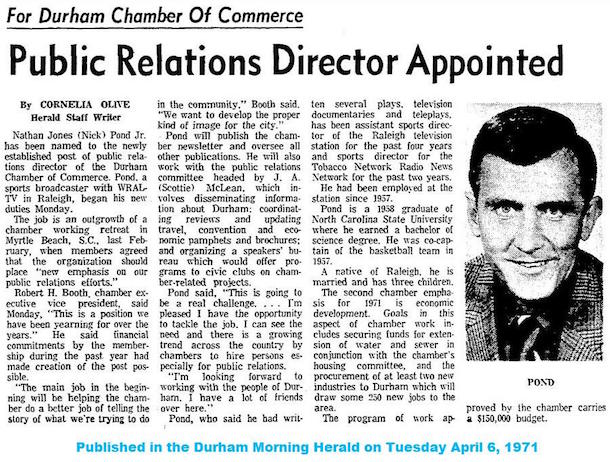
WRAL News personality Nick Pond hosted the Raleigh-only version of the Jim Crockett Promotions wrestling show known simply as Championship Wrestling in the 1960s and very early 1970s.
Pond left WRAL at the end of March, 1971 to become the public relations director of the Durham Chamber of Commerce. He stayed with that job until August, 1973. He returned to WRAL shortly thereafter as a news anchor, but never called wrestling again.
During at least part of the time (and perhaps the whole time) Pond was working at the Durham Chamber, Elliot Murnick (son of Raleigh area promoter Joe Murnick) hosted the version of the Mid-Atlantic show that was exclusive to the Raleigh market.
Soon after, the dual-tapings ended, and Crockett began taping two different versions of Mid-Atlantic Championship Wrestling. The first, hosted by Bob Caudle (who had hosted the syndicated All Star Wrestling for over a decade), was the "A" show that went to all Crockett TV markets. The second, the "B" show hosted by Les Thatcher, went to markets where JCP was able to barter both shows. Usually (but not always) the second "B" show aired on a different station in that market.
Clipping courtesy of Carroll Hall.
HOME | MID-ATLANTIC BOOK STORE | STUDIO DIRECTORY
ABOUT | CONTACT | MID-ATLANTIC GATEWAY
Visit the DESKTOP VERSION of the website for tons of FILTER OPTIONS to find info on your favorite announcer or studio location. Filter options are located on the right side of the web/desktop version of the website.
Wrestling Audience Greatly Expanded by TV Saturday
By Bob Gillespie, Charleston Post & Courier, September 23, 1978
TV wrestling – a success story? Go ahead. Laugh. That’s just what both the pro wrestling promoters and local television stations are doing, all the way to the proverbial bank.
For several months now, I’ve followed this TV sports column and I have yet to see anything written on what has to be the tube’s most successful enterprise in the realm of sports. I shall now try to correct this omission.
What am I talking about? Football? Basketball? Women’s field hockey? Tournament-level tiddlywinks? “No” to all the above.
Try professional wrestling.
"Wrestling?" you ask, looking down your cultured nose with disdain. That Roman gladiator spectacle of the masses, with costumed clowns flying through the air like so many comic book characters? TV wrestling – a success story? Surely I jest, you say. And you probably laugh.
Go ahead. Laugh. That’s just what both the pro wrestling promoters and local television stations are doing, all the way to the proverbial bank.
The fact is, wrestling, especially on television, has been growing in popularity over the last few years – by leaps and bounds greater than any you’ll see in the ring. And no one realizes – and appreciates – that fact more than Charleston area television management.
On any given Saturday, year round, the Charleston viewer can see wrestling twice in one day. That’s if he doesn’t have cable TV. If he does, add another show on Saturday and one on Sunday. And if you live far enough toward Savannah where you can pick up that city’s television, you can catch two more showings, or five more programs per Saturday.
There’s a reason that pro wrestling is on so often: it’s popular.
“The shows are rather popular in this area, I know that,” says WCIV-TV (Channel 4) Program Director Don Moody. “If we have to move the show (1 pm Saturday) for a network thing, we really get the phone calls.”
Program Director Jim Shumaker of WCBD-TV (Channel 2), whose station carries wrestling Saturday night at 11:45, is even more emphatic. “It’s just unbelievable,” he said. “It leads its time period against all comers. People in this area are really hung up on this wrestling.”
How hung up? “In the last important ratings book, which was back in May, wrestling at midnight Saturday was pulling a 52 percent share of the audience,” Shumaker said. By comparison, Saturday Night Live on NBC (Channel 4) gets 32 percent, while Channel 5 (WSCS-TV), carrying Blockbuster Theatre, takes a 21 percent share.”
Channel 2 isn’t the only beneficiary of wrestling, either. When Channel 4 runs wrestling at 1 pm, it gathers in 46 percent shares of the audience at that time, as opposed to 31 percent for Soul Train (Channel 5) and 19 percent for American Bandstand (Channel 2). “They’re obviously doing something right,” added Shumaker.
“They” in this case is an outfit called Jim Crockett Promotions out of Charlotte, NC, who provides their Mid-Atlantic Championship Wrestling in the Carolinas/Virginia areas. Crockett not only handles the live events at local arenas, such as Charleston’s County Hall operation on Friday nights, but also produces the television shows, filming them weekly at WRAL-TV in Raleigh, NC.
The most ironic thing about the whole operation is the deal between Mid-Atlantic Championship Wrestling and the local television stations. The stations get a program with a high rating – virtually for free.
“Crockett supplies us with the taped program,” Shumaker said. “We give them two one-minute-40-second commercials for promotion of their local wrestling matches. We get the program, which leads its time slot, plus 10 minutes of commercial time to sell. And they’re easy to sell, too.”
Why give away a program when stations that run movies or even network programs against the wrestling - and still lose out – are paying big bucks for those time-fillers? Henry Marcus, who promotes wrestling for the Crockett operation in this area from his Columbia base, has an answer.
“It’s simple,” said Marcus, who started wrestling promotion in 1934. “Television is great, whether you’re selling wrestling or tooth paste. It’s the greatest advertising device man has ever invented. When you can have 75 million people watch the Ali-Spinks fight, you can’t beat it.”
The Crockett TV blitz started “about 18 years ago under Jim Crockett, Sr., the father of the Jim Crockett who runs the operation now,” said Canadian native, Sandy Scott, himself a former popular wrestler who now promotes the Mid-Atlantic product in Roanoke, VA, after covering the Greenville area the last three years. “The first station was Channel 7 in Roanoke in 1950 or so, and the second was WFBC-TV in Greenville.”
Scott, like most people involved in TV wrestling, is at something of a loss to explain its popularity. “I don’t know for sure, but it’s tremendous. Of course, we feel we offer the top wrestling talent, and the best will always hold the audience.”
“Wrestling did well without television, but TV has expanded the number of people we reach,” he added. “Folks in smaller towns see it now.”
The only thing that may be holding pro wrestling back now is the item referred to at the beginning of this piece: its image. Sportswriters and some sports fans deride pro wrestling, question its status as legitimate sport. That’s actually putting it mildly; wrestling is often called a fake, a circus, a joke and the like.
I’m not getting into the merits of such arguments. I like my skin in one piece, thank you. As one local television sportscaster put it, “I used to call wrestling a phony, but I learned you don’t do that in a crowded bar.” But the arguments against wrestling still exist.
If the arguments don’t seem likely to change, though, the image may be doing so. “The wrestling programs on TV draw all spectrums,” Channel 2’s Shumaker noted. “We sell it locally, but our national salesmen say the general feeling among the big sponsors is that wrestling appeals to the ‘blue collar and beer’ crowd.”
“That’s not necessarily so. It seems to be drawing more young people, but it gets men, women and children, all ages. They seem to be expanding the market.”
For sure. Said Marcus, “Our TV survey man in Charlotte estimated that on any Saturday, some 1.1 million people are watching wrestling on stations in the Carolinas and Virginia.” “Blue collars and beer” or not, that’s a heap of potential customers for the TV sponsors.
So whether you love wrestling, hate wrestling, or just don’t care, you’ll keep on seeing it on the tube for a long time. “We tend to take it for granted that it’s going to capture its time slot,” Shumaker said. “I guess you’d have to call it a success story.”
And television is not inclined to give up success stories.
*********************************
Photos and graphics were added by the Mid-Atlantic Gateway, and were not part of the original article.
HOME | MID-ATLANTIC BOOK STORE | STUDIO DIRECTORY
ABOUT | CONTACT | MID-ATLANTIC GATEWAY
Visit the DESKTOP VERSION of the website for tons of FILTER OPTIONS to find info on your favorite announcer or studio location. Filter options are located on the right side of the web/desktop version of the website.

